Thank you both for the replies; makes a lot more sense now.
Incidentally, dw i’n gweithio am yr eglwys (dim yng Nghymru) and have been following Bangor’s current issues quite closely. Fedru i ddim gwrando amdano fo yn y Gymraeg ar Radio Cymru, though
This last one is another really useful site - if you have an idiomatic phrase and you’re not sure how it would be expressed in Welsh (say, to rule something out) you can search on it (because of English syntax “rule out” would be the search term in this case). Then the site will pull up every time it has cropped up in speeches transcribed in the Senedd, along with the official translation that was published. That way, you can see a variety of solutions for that particular translation issue. I find it really handy!
I find it helpful when a dictionary gives you multiple options and you don’t know if they’re exact synonym or how to use it etc - once you’ve searched for a word if you click on the dropdown menu for each of the results it’ll give you an example text fragment (where available) using that word.
And another very useful website – that’s great, thank you!
This morning I wrote tafod mewn boch thinking it couldn’t possibly be the correct idiom, but now, thanks to your link, I know that at least some Very Serious People in the Senedd use the expression…
I’ve got 2 questions today which I’d be grateful for some help please.
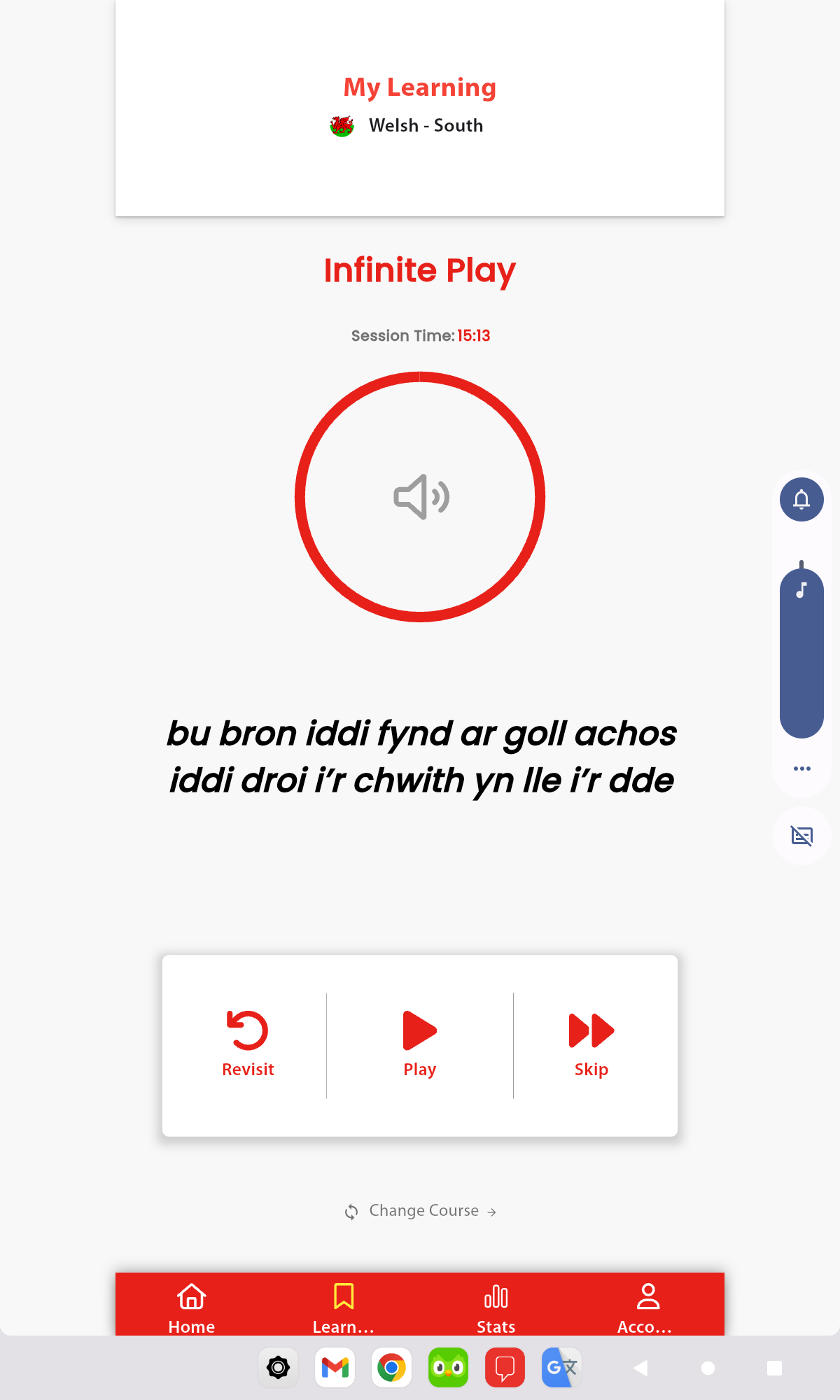
In the first, “she almost got lost etc”, why does"iddi droi" appear instead of some past tense of turn - I was expecting something like “wnaeth hi droi…”? Is it something to do with “achos”?
I’ve seen several cases where "iddi"has appeared instead of “hi” and it has caught me out.
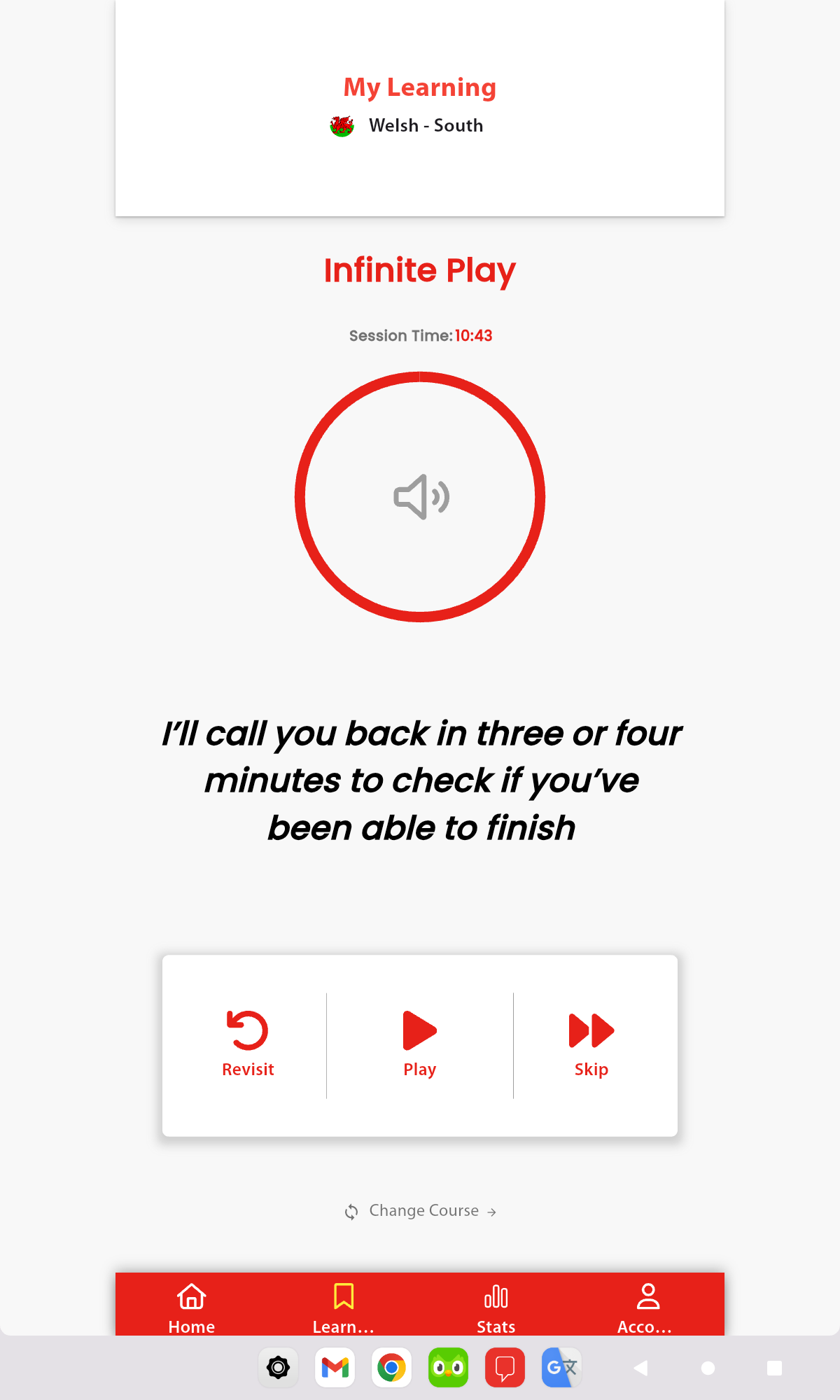
In the second case, what has happened to the “os” for “if”? It is optional in this case due to some hithero unknown (to me) rule? As an added bonus I did learn that "gweld"also has the meaning of “check”.
Yes, it has very much to do with achos. Usually, achos is used with “that”-constructions, so it’s structurally the same as reported speech, with the basic form being achos bod. So you could say achos bod hi wedi troi i’r chwith….
But if you want to express past events in reported speech, it’s shorter to use the i form, which implicitly puts the clause in the past. The inflected form of the preposition i in this case is iddi, and in speech, iddi hi is often shortened to just iddi, giving you the final achos iddi (hi) droi i’r chwith…
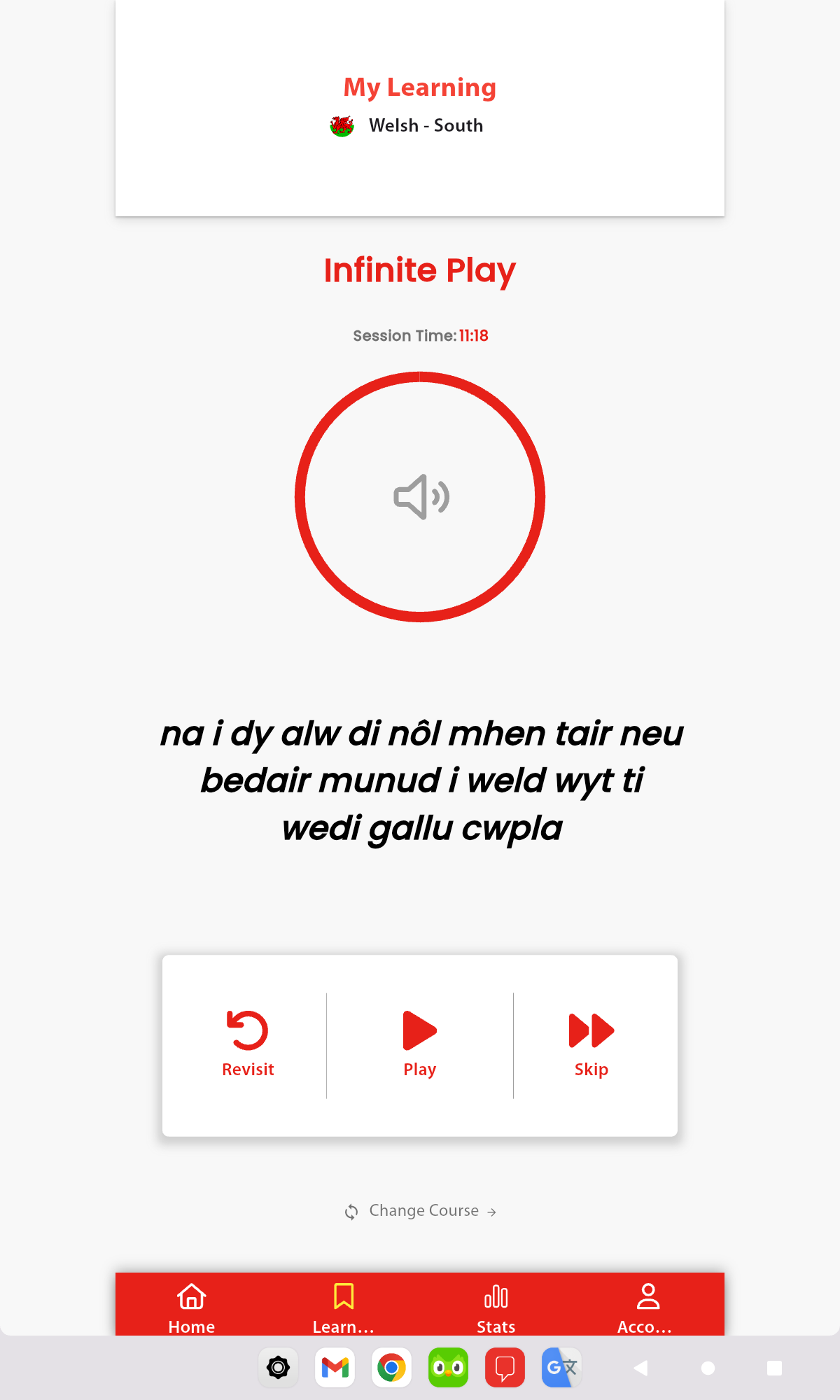
(The other thing you mentioned is that sometimes the personal pronoun hi is replaced by ddi in speech, for example Ble mae hi? → Ble mae ddi?)
As for the missing os in your other question, I can only guess that it is a typo.
I was wondering if it might be that an a had vanished in speech, like y and a do from relative clauses. But I may be utterly wrong… @nigel-28 Traditionally, Welsh doesn’t use os for ‘if’ when it means ‘whether’ (I’ll call to check whether you’ve finished) - instead it uses a, which is the kind of tiny little monosyllable that tends to vanish in casual speech. More and more people say os these days, as in English, but it ‘should’ be a, here. I don’t know if my guess (that it’s a in theory but missing in practice) is the correct explanation, though.
Assuming you’re correct I guess it points to one of the disadvantages of the little or minimal grammar approach. There is no way a learner could divine what you say without for example, some kind of learning prompt. And it just leaves the learner (i.e. me) baffled and confused! But of course, thankfully the good people of this forum will always help.
I had a quick look at the Gareth King’s books I recently purchased but couldn’t find any reference under the “os/if” sections.
Hopefully, our admin team can confirm whether it was indeed a typo or some grammatical nuance along the lines you suggest.
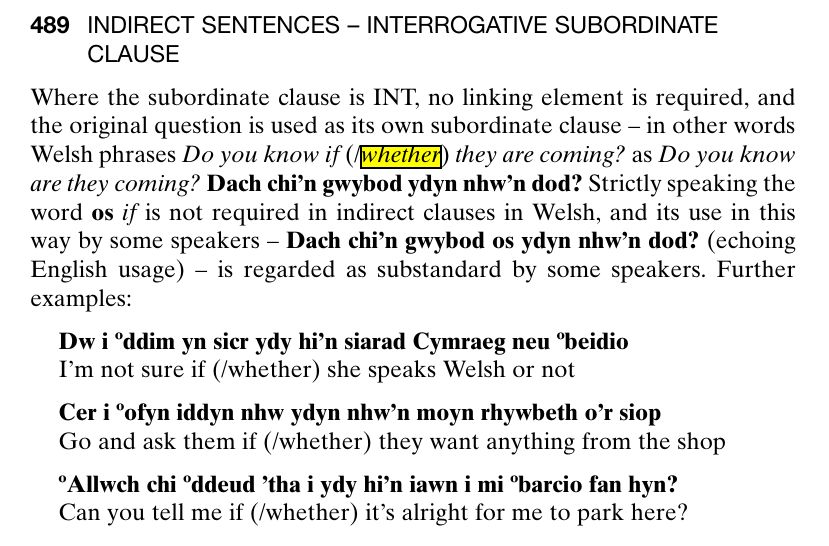
Well, it seems I was nearly right: Gareth doesn’t mention a missing a, but he does say that you don’t need os. “INT” just means ‘interrogative’, ie these if/whether sentences are just complex sentences where the subordinate bit is actually a question.
From the 2nd edition of his grammar:
Yn hytrach na, this has been introduced well through level three. Yn hytrach nag was introduced ages ago, did I make up the ‘g’, or was that instead and this adds the of?
Both mean the same, the only difference is the word that follows na: if it starts with a vowel, you use nag, to seperate the two vowels. The same thing happens with the conjunction a (and) – Megan and Owen is Megan ac Owen (not “a Owen”).
If you can say ‘whether’ instead of ‘if’, it’s a (or nothing) not os.
‘Please come if you can’ Dewch os medrwch (‘Please come *whether you can’ doesn’t work)
‘Do you know if he can come?’ Wyt ti’n gwybod (a) fydd o’n medru dod? (‘… whether he can come…’ is fine).
I’m thoroughly enjoying working my way through the excellent “Modern Welsh” by @garethrking but have a question about 167: Un in idiomatic expressions.
The example is “Brynes i’r un llun”, I didn’t buy a single picture.
If I were using ddim for a negative without stressing the “un”, I’d expect “Phrynais i ddim llun”. So why no aspirate mutation for this negative? Is it the lack of the (implied) ddim?
It has nothing to do with whether the negative is implied or not. You are correct in your thinking that if you want to be grammatically correct, in case of negative statements you’d need the aspirate mutation for verbs beginning with p, c or t and the soft mutation only for letters not susceptible to aspirate mutation. But the fact of the matter is that in everyday spoken Welsh the aspirate mutation is gradually vanishing, so a lot of people will just use the soft mutation in such sentences.
(Or just ignore the mutation completely in things such as te a coffi instead of te a choffi)
Hi Chris - yes, it’s as Hendrik set out…the SM is generalised for verbs with endings in many spoken types, whether it’s on questions (the only one the standard language allows), or negatives (like your example), or indeed positive statements. So in speech, quite frequently, one might even say uncontroversially: Brynodd hi garShe bought a car Brynodd hi gar?Did she buy a car? Brynodd hi ddim carShe didn’t buy a car.