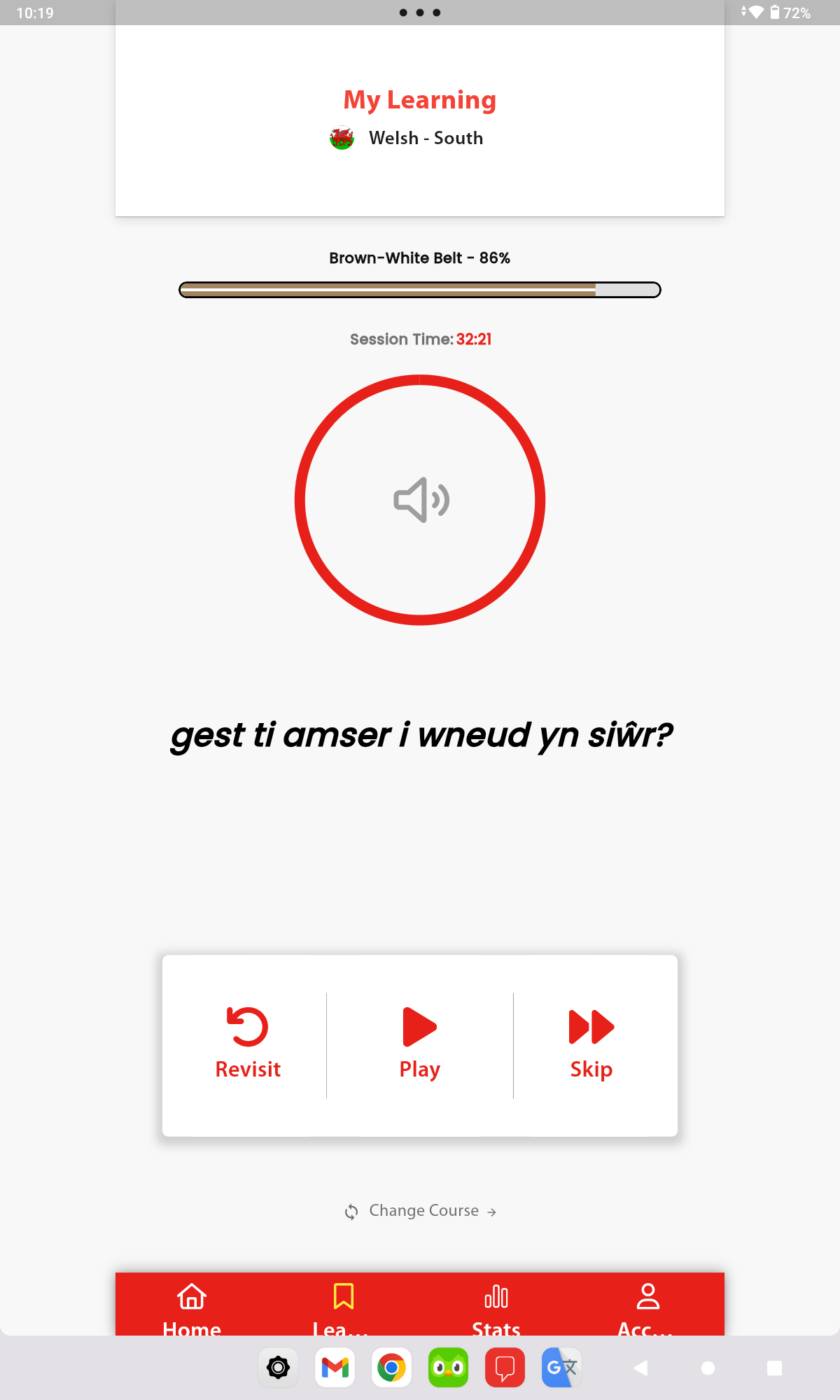
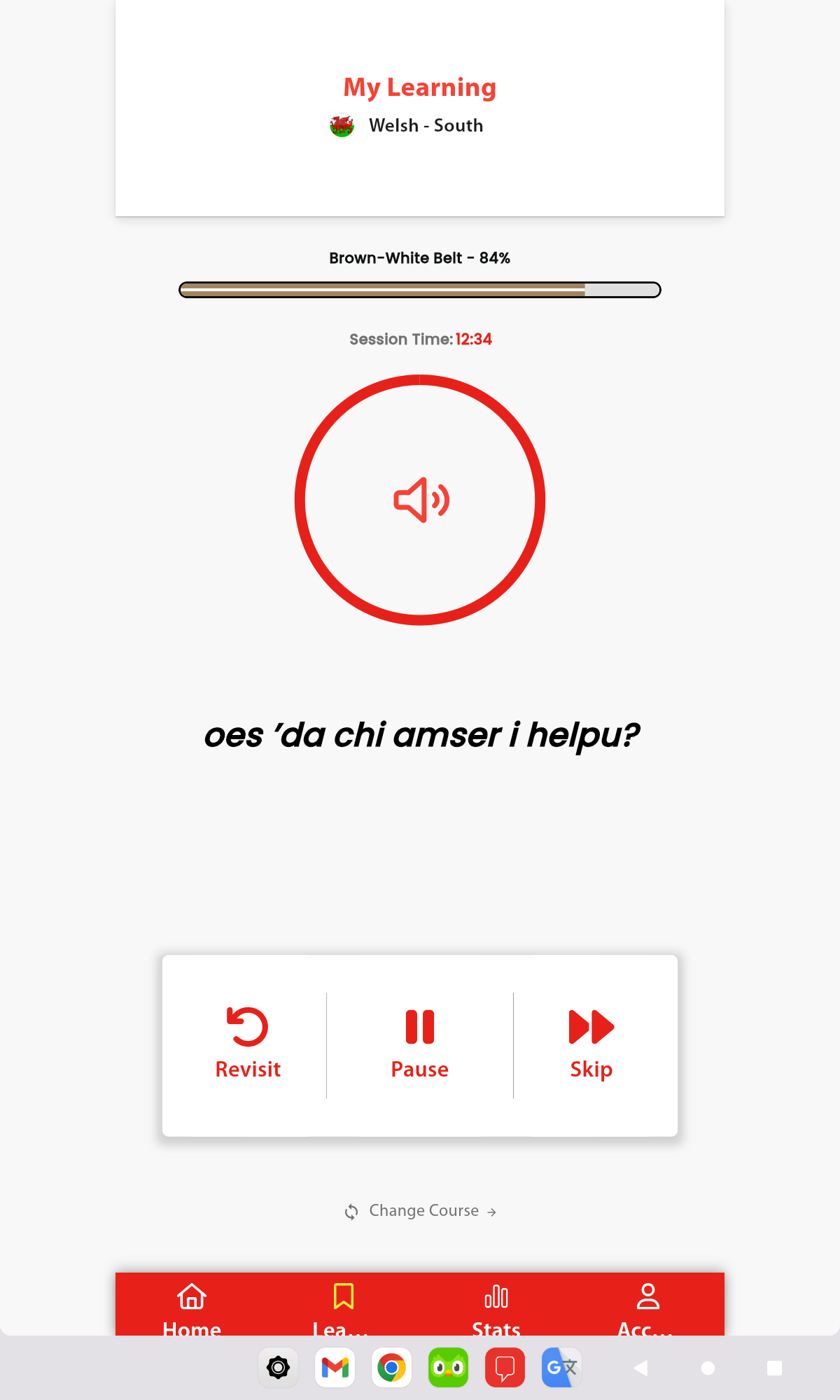
Dyw hi ddim yn bosib i gael ‘bwlch’ yn yr enw, felly gobeithio bod hwn yn iawn.
It’s not possible to have a gap in the name, so I hope this is OK.
Dyw hi ddim yn bosib i gael ‘bwlch’ yn yr enw, felly gobeithio bod hwn yn iawn.
It’s not possible to have a gap in the name, so I hope this is OK.
Diolch o galon Deborah, mae’n reit neis!
I didn’t take a screenshot but in today’s session I’m sure I saw “wnes I ddim gwybod” and “do’n I ddim yn gwybod” for ‘I didn’t know’. It threw me a bit although it could be my memory playing tricks.
Did I see both?
Yes, one is used for a longer standing lack of knowledge, the other a more immediate not knowing. But I haven’t managed to work out which is which yet.
Maybe. But I couldn’t tell from the ssiw sentence!
do’n i ddim yn gwybod is the longer term one (“I wasn’t knowing”) and wnes i ddim yn gwybod is the more immediate one (“I didn’t know”), but of course we don’t say “I wasn’t knowing” in English, so both translate as “I didn’t know” and the difference in welsh comes from context. If in doubt, I’d say go for the do’n i ddim … - you’ll still be understood.
Thank you, I trusted that you would be along to clear up my poor attempt at an explanation.
Fod o’n vs bo hi’n, how do i know? Is it to do with the masculine or feminine of sonething in the sentence?
Diolch
Yes, that’s exactly it. fod o’n is for “that he” or “that it” when the ‘it’ is masculine, and bod hi’n is for “that she” or “that it” when the ‘it’ is feminine.
Thank you.
Ddudest ti fod o’n eitha da.
Do’n ni ddim yn meddwl bod hi’n sothach llwyr.
Excuse my spelling please.
What is the it? That is male or female here.
Every noun in Welsh is either masculine or feminine, so the “it” in the first sentence could be a book (masculine), in the second sentence “it” could be a film ( feminine)
And another,
Her is iddi, sometimes in a sentence it’s just iddi, other times iddi hi.
What am I missing?
This is just one of the variations in spoken Welsh. The preposition i changes for some persons, so instead of “i hi” you get the correct form iddi hi. And then some people just drop the hi.
Example: I want to give her a present – Dw i eisiau rhoi anrheg iddi (hi).
Ah! Many thanks, I did wonder. Very kindly a few other little things have been explained here, as variation. The forum is such a boon.
Diolch
Today I thanked someone and got back “mae croeso i chi!”
I’ve not seen this before. Is it common in a particular area or teaching course, or a more formal register? Until now pretty much everyone I’ve encountered just says “Croeso!”
Are there any more options for conveying “You’re welcome”?
It’s a bit more formal, but just personal preference really. You may get the full mae croeso i chi/ti, or croeso i chi/ti, or just croeso.
Cadno neu llwynog yn ne Cymru?
Diolch
Usually fox is cadno in the South and llwynog in the North.