I’m not sure what you mean by this - is that part of the full file name?
Eh?
Maybe so - nonetheless, it’s effectively because it isn’t easy that it will trigger neurological change that will make understanding real speakers easier…
I suspect you mean C1WelshListen02s - file names really benefit from being written in full, because subsets of them can crop up in multiple situations - like, for example, C2WelshListen02s! - so when we’re trying to figure out what/where you’ve downloaded, it’s better not to shorten…
Grovel!!! I forgot it wasn’t just thee and me.. I shorten everything for speed when typing if I think the context makes it clear!!
To @aran More Grovels!! I found the practice!!! It was further up the listings, of course it was, Jackie, you idiot!!! 02 comes before 10… so it was near the top!!! Grovel!!! To anyone else who has read this far, salutary lesson!!! Think logically and all may become clear!!!
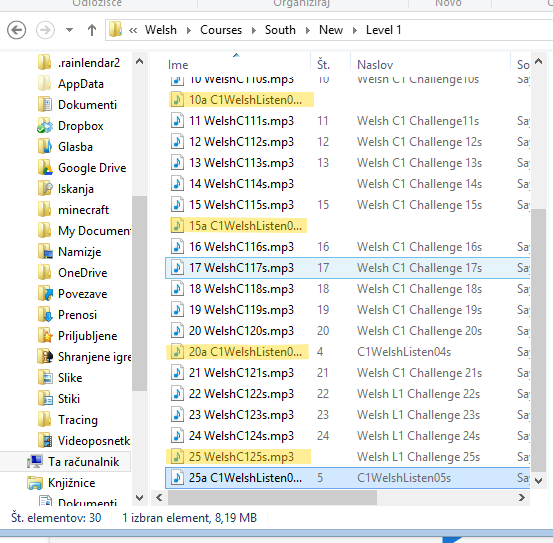
Or alternatively: When I store the lessons/practices I always add eqvivalent number infront of the name - for example 01 and then the name of the file I leave untouched. Listening practice for level 1 Challenge 5 would have 05a number so it comes directly after Challenge 5, 10 would be 10a etc … This for I never mix the lessons and I know exactly where they are.
But if you want to preserve the original name and still add the number infront, you shouldn’t just type (as the name when you saving is usually marked in whole and if you type anything you tend to delete it) but click on the beginning of the name when asked where to save first and then put the number infront of the name. Inbetween number and filename I use space so it’s even more clear what you are looking at. Also don’t forget to add that “0” infront of lessons/practices from 1 to 9 because if you forget that the order will change - 1 comes first, then 10 etc …
I hope it helps people less lazy than me!!! I shall leave the names they come with and remember what they are for the short time they are relevant!!! :
I did L2C20 today, and not sure what’s happening with ‘meddwn nhw’ (unsure on spelling!). What’s the root for meddwn? I can feel that I’m going to get confused between ‘they said’ and ‘they thought’ because meddwn and meddwl are much similar than meddwn/dweud/ddidest/ddidov!
Haven’t listened to it, but the root is “medd~”.
“Medden nhw”, “they said”, I presume?
Bit similar to “quoth”, if English were still using “quoth”.
Context will prevent any confusion, worry not! Even if “meddwl” (root "meddyl~) were used that way.
But context will always make it clear! All languages have words which sound similar- how often does that cause you problems in English?
Hopefully a genuinely quick question: What is the difference between ‘medru’ and ‘gallu’, I’m mixing them up, as they both seem to mean ‘to be able to/have the ability to’?
I think the only difference is that “gallu” is used mostly in the South and “medru” mostly in the North. As you say, they basically mean the same thing.
I asked Tom (first language speaker) this, he grew up in South Wales but his Mam (and grandparents/uncles/cousins etc!) are all from North Wales. He uses gallu for a more permissive “can”, more like “may” and medru for an affirmative “can”, as in “yes I can” or “if I can”.
Not sure if that helps or confuses though! You’d be understood either way!
In everyday speech, gallu and medru are divided fairly much by geography - northerners use medru, southerners use gallu.
Technically, the difference is that medru is knowing a skill, and gallu is more having the capacity to. So everyone “gallu” speak Welsh - it needs a working voice box / tongue / lips etc. But in order to m"medru" spaek Welsh, you need to be lucky and start off early, or put in a lot of effort to learn later in life.
Quite a few other languages have this distinction. French and Slovak are two that I know for, which makes me think that Slovenian is likely to have as well (@tatjana?)
Unfortunately, in spoken Welsh, it has almost entirely disappeared, except in some phrases that you will sometimes hear.
C2(N)G21
I’m getting really confused about placing possessives.
I want to be bale to say “I love her cat”
Is it 'Dwin caru’w nghath hi"
If so is “I am loving her cat” “Dwin fy garu fi ei nghath hi” ?
But to all horror, “Jaz lahko” has other meaning too. Something like I can probably take this, cant I? = “Verjetno jaz to lahko vzamem, ali ne?” what in our language has totally different context meaning then “znati” (infinitive of “(jaz) znam” in “moči” = infinitive of “(jaz) lahko”.
However, playing a bit with Slovene version of SSiW I came to many problems even at the very beginning where “gallu” was explained in Cymraeg because one time you contextually can explain it like “znam” and the other time like “lahko” … so I have no idea how would SSi cope with this problem though. … (oh, but this is probably not mine to think about and I went a bit too far with my right to even think about these matters which might not be my business at all. Sorry about that … ).
Sori, I think I’ve confused myself because we were introduced to possessives with ‘caru - to love’ without really realising it
so “I love sailing” would be “Dwin caru hwylio”
and “I love her sailing” would be “Dwin caru ei hwylio hi”?
Would it be fair enough to say that you will (at least sometimes) come across “gallu” in the north, but perhaps only rarely come across “medru” in the south?
I’ve been reading a lot of Bethan Gwanas (who is from near Dolgellau, I believe) lately, and I find a lot of use of “gallu” in its various forms. It could be that she is preserving the distinction that you are talking about @Iestyn as this is written language (although generally in a highly colloquial form). (I’ll have to try to see if I can notice the difference when she uses one or the other).
However, I notice other things that I would think of as “southernisms” in her writing (like “gyda”), and even “yw” (e.g. in the title “Hi yw Fy Ffrind”), so maybe she just likes to mix up the types of language.
(or maybe they just speak “funny” in Dolgellau… ).
Cath = cat.
Ei chath = her cat.
Ei chath hi = her cat.
Ei chath hi = her cat.
Dw i’n caru ei chath hi = I love her cat.
Dw i’n caru ei chath hi = I am loving her cat.
[if you ever want to say “I am loving her cat” rather than “I love her cat”. It’s the same thing in Welsh, and I can’t see the difference- or indeed, when you would say it in English ]
Ei gath = ei gath e = ei gath o = his cat
Substitute and etc.



 :
:
 ).
).