Thanks Cetra. I’ll raise that with the Tech Team as I can’t imagine it would be language specific. It’s likely to be a more general issue.
1 Like
‘but you won’t’ is ‘aber du willst’ without a ‘nicht’.
The male voice adds extra sounds to ‘die Hoffnung verlieren’ when its introduced, ‘Nein, es wäre besser, direkt nach Hause zu gehen, und’, ‘to stop’/‘anzuhalten’ and ‘to become finished’/‘fertig zu werden’.
The female voice make some extra noises on ‘mit unseren Kindern’ and ‘sie ist’.
And ‘we want to become more patient’ is ‘wir wollen geduldig’ so might need a ‘werden’ on the end?
The male voice doesn’t pronounce the ‘t’ on the end of ‘direkt’ when its introduced.
For ‘to go directly to home’ the male voice says ‘direkt nach Hause.. (pause)… Hause zu gehen’.
One of the English prompts for ‘irgendwo’ is ‘I need my keys’.
The male pronunciation of ‘erwarten’ when its introduced isn’t good.
The female voice doesn’t say ‘work out fine’/‘schon klappen’ properly.
Neither model voice says ‘try to’/‘versuchen’ properly.
Not sure that ‘to’ = ‘gerne’ on its own works as a translation, and I think that the first time its introduced the male voice makes a random noise.
For ‘if we’/‘wenn wir’ the female voice says ‘wenn wie’.
The male voice adds some extra sounds to ‘sie wollen die Führung’, ‘wollen sie jetzt’, ‘diese Armeisen töten’, ‘serve the community’/‘der Gemeinshaft dienen’, ‘of everyone’/‘von allen’, they’re just wasting’/‘die verschwenden nur’.
The male voice for ‘the leadership’/‘die Führung’ sounds more like ‘duh Führung’ and ‘the time’/‘die Zeit’ more like ‘duh Zeit’.
When ‘take over’/‘ubernehmen’ is introduced both voices sound more like ‘ubernem’.
The male pronunciation of ‘töten’/‘to kill’ and ‘like them’/‘sie mögen’ isn’t good, and neither is the female pronunciation of ‘nicht töten’, ‘they don’t need’/‘sie müssen’ and ‘like them’/‘sie mögen’.
When ‘a’/‘eine’ is introduced the English voice first says ‘a’ to rhyme with ‘hay’ but the second time he says ‘ah’.
The male pronunciation of ‘just’/‘nur’ isn’t good.
The male pronunciation of ‘sie wúrden aber’ and ‘du kannst’ isn’t good.
The female pronunciation of ‘sicherstellen’ and ‘für die’/‘for them’ isn’t good.
The first time the male voice says ‘gerne’/‘like’ isn’t good.
The English pronunciation of ‘mean’ isn’t good.
The various examples that talk about ‘they’ and ‘waste’ like ‘they waste’/‘die verschwenden’ should all probably be ‘sie’ not ‘die’.
For ‘Would they like to visit us’ the female responds with just ‘möchten sie’, and the male has extra noises.
The male also add extra noises to ‘möchten sie uns’.
For ‘would they like to visit us now’, ‘would they like to visit us again’, and ‘would they like to visit us on Tuesday’ neither model voices say ‘besuchen’. They just respond with ‘möchten sie uns jetzt/wieder/am Dienstag’.
The male voice adds extra sounds to: ‘of the students’/‘der Studenten’, ‘approach’/‘annäherung’, ‘nicht annäherung’ , ‘sie dachten aber’/‘they thought but’, ‘themselves’/‘selbst’, ‘nicht ein Teil’/‘not a part’, ‘unsere Freunde kamen’/‘our friends came’, ‘in front of’/‘vor dem’, ‘nicht alle bereit’, ‘kostenloses Angebot jetzt’, ‘ich warte auf’/‘I’m waiting for’, ‘Halbzeit’/halftime’.
Male pronunciations aren’t good for: ‘began’/‘anfing’, ‘should do’/‘tun sollte’, ‘to die’/‘sterben’, ‘be able to make broken’/‘kaputt machen können’, ‘are’/‘sind’, ‘the train’/‘den Zug’, ‘Leute die gerne’, ‘könntet ihr’/'could you (plural), ‘told’/‘gesagt’, ‘nicht neben’, ‘seit dem’/‘since the’, ‘der Ferien’ - sounds like ‘duh Ferien’.
The female ‘to develop’/‘zu entwickeln’ sounds like ‘zu entwickelned’, and her pronunciation isn’t good for: ‘wen sie’/‘who they’, 'how/‘wie’ and she doesn’t doesn’t pronounce the ‘t’ in ‘ihr macht’/‘you all are doing’.
Not sure why the English translation needs to be ‘in the nearness’ rather than just ‘near’. I think its a bit off-putting when the English isn’t natural - its as if you have to work out the English meaning first.
Sometimes the English pronunciation of ‘can’ is more like ‘cahn’ in phrases like ‘that we it not change can’ (which doesn’t make sense anyway).
Not sure that ‘es war nicht blauen Schild’/‘it was not blue sign’ works in either language.
‘A shop where I can buy postcards’ is missing the ‘ich’ in the German - ‘ein Laden wo Postkarten kaufen kann’.
The first two times the male voice says ‘is that’/ist das’ he just says ‘das’.
Sometimes the skip button doesn’t work and pressing it a second time gives the error message below. When the error message goes, the app is paused so you have to press play to continue.
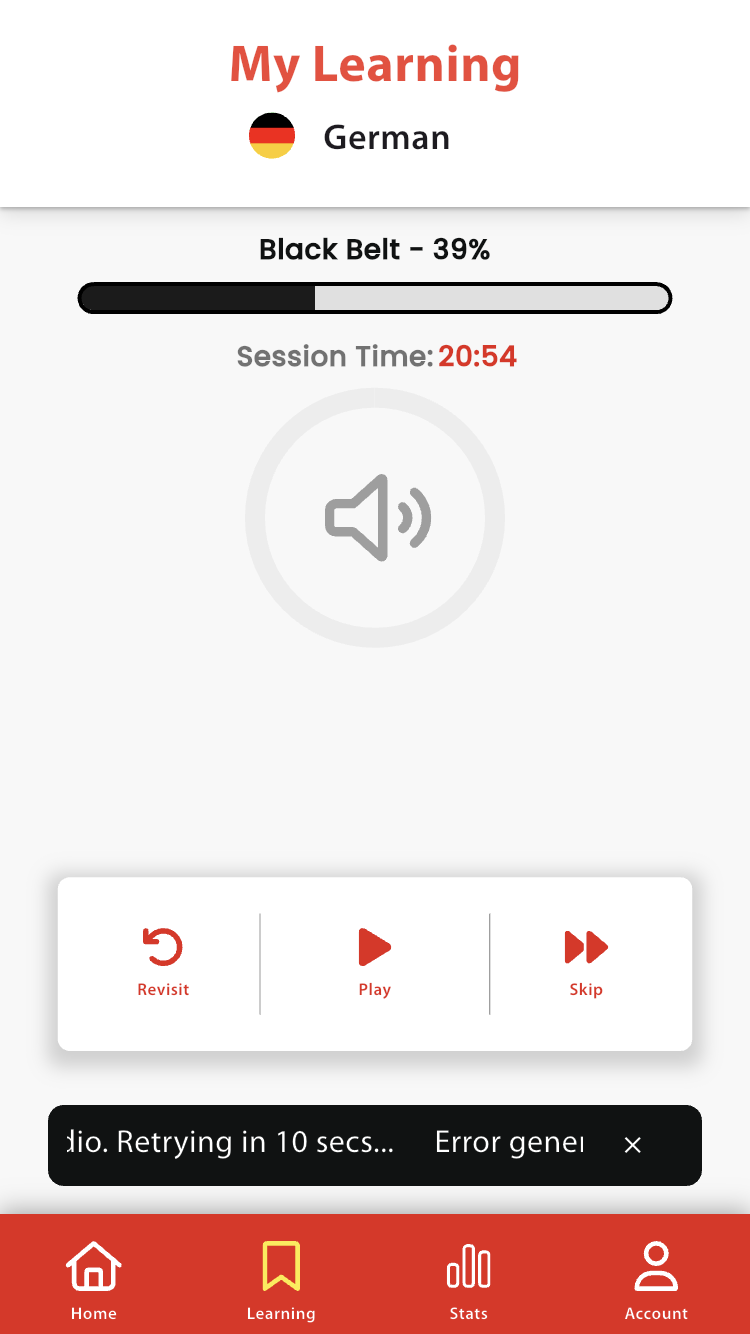
Danke Cetra. That happens when there’s a missing audio file and the app tries to access it. As part of the production process, we now have a programme that runs through to check for those. It will need to be run on the German course once all the points you’ve raised have been dealt with. Diolch yn fawr for your thorough testing of the course! I hope you feel that you’re able to speak quite a lot of German now as well.
1 Like
I’m not sure about the equivalence of ‘not far’ and ‘nicht mehr weit’.
The female voice just makes a noise for ‘wir mussen jetzt’.
The male voice just makes a noise for ‘das Leben jetzt’ and ‘das Leben und’.
The female pronunciation of ‘einfach sein’/‘to be easy’ isn’t good.
The male pronunciation of ‘macht’ on its own isn’t good. Also: ‘ersten Teil’/‘first part’, ‘nach dem’/‘after the’, ‘and which of’/‘und welche von’, ‘die Tür aufmache’.
The English text and the timer was missing for ‘when it’/‘wenn es’, and the English text was missing for ‘allein’.
The English text was missing for ‘I like how you try to help’ and ‘how you’/‘wie du’ and both German voices didn’t pronounce ‘wie du’ properly.
Both the male and female intonation of ‘passiert’ is sometimes a bit off.
The male voice doesn’t pronounce the ‘f’ on the end of ‘Schlaf’ both on its own and in ‘some sleep’/‘etwas Schlaf’.
Neither voice pronounces ‘du brauchts’ very well.
The male voice adds extra sounds to ‘zu verlieren’/‘to lose’ and ‘nicht als ob’.
The male pronunciations of ‘das’/‘gehört’ , ‘found’/,gefunden’, ‘came’/,‘gekommen’, ‘moved’/‘gezogen’, ‘about it’/‘darüber’, ‘yet’/‘noch’, ‘du vergisst noch’‘, ‘wir bleiben mussten’, ‘can win’/‘gewinnen kann’, könnt ihr heben’, ‘könnt ihr alle’, erzählt hat’, ‘das du sagst’, ‘in this’/‘bei diesem’, ‘he has’/‘er hat’, ‘du wütend bist’, ‘der Hund ist schmutzig’, ‘das Ende’, ‘such loud’/‘so Laute’, ‘es geht’, ‘been able to’/können’, ‘für alle’, ‘warmer’/ ‘wärmer’, ‘wo es’/‘where its’, ‘gladly’/ gerne’ aren’t good.
Both the male and female pronunciations of ‘to me’/‘mir’ and ‘passiert sind’/have happened’ aren’t good.
The male adds extra sounds to ‘uber’, ‘den Rasen’/‘the grass’, ‘deine Freund’, ‘for a’/‘fur ein’, ‘wahrend ich noch’, ‘des neuen Jahres’, ‘stay behind’/‘zurückbleibe’, ‘noch nicht gesehen’, ‘der ganzen Familie jetzt’, ‘um zu prüfen’/‘to check’, ‘fertig geworden bist’, ‘ich soll’/I’m supposed to’, ‘sie erzählen’, ‘ich lag’/‘I lay’, ‘is’/‘ist’, ‘wir haben es’/‘we have it’, ‘wir wollten aber’.
Both voices add extra sounds to ‘Ich werde uber’/‘I will over’.
The female voice adds extra sounds to ‘the most’/‘am meisten’, ‘am ersten’, ‘warum wir’/‘why wir’.
The female pronunciations of ‘guess once’/‘rate mal’ (not sure why that needs to include ‘once’ in the English), ‘who told me’/wer mir’ (seems to be lacking a ‘told’), ‘auf jedes Wort’, ‘late’/spät’, ‘nach oben’/'‘upstairs’, ‘thoroughly’/‘gründliche’ aren’t good.
I don’t think the literal English translation for ‘Ich habe nicht vor zu verlieren wenn es wirklich darauf ankommt’ as it doesn’t really make sense - ‘I don’t have in front to lose when it really comes on it’! 
The English pronunciation of ‘sad’/‘traurig’ is sometimes ‘sed’.
The male pronunciations of the following aren’t good: ’ zwanzig’, ‘he has’/‘er ist’, ‘trotzdem teilen’/ ‘still share’, ‘meine Spielsachen’/ ‘my toys’, ‘meine Augen’/‘my eyes’ (the first two times it comes up) ‘gehört hat’, ‘du warst’/‘you were’, ‘woanders’/‘elsewhere’, ‘wo deine Familie’, ‘dass war sehr’, ‘gesehen haben’/‘saw’, ‘kaputt war’/‘broken was’, ‘dass’/‘that’, ‘ich wusste nicht dass’, kaputt gemacht hatten’/‘broken had’.
The male voice add extra sounds to: ‘gerade gesehen hat’, ‘ich musste meine Spielsachen’, ‘wir brauchten nicht’.
The female pronunciations of the following aren’t good: ‘told me’/‘mir gesagt’, ‘abgefahren ist’, ‘wie ich wäre’, ‘her’/‘ago’ and the English pronunciation of ‘ago’ isn’t good either.
The English pronunciation of ‘close’ as a verb is with an ess sound rather than a zed, and ‘lives’ as in ‘to live’ is pronounced like the plural of ‘life’.
There is no male voice for ‘the children it’/‘die Kinder es’ just a hissing noise.
Hurray, I’ve got to end end of black belt! 
A bit disappointingly there was no celebration or acknowledgement that I’d reached the end, it just slipped into Infinite Play almost without me noticing.  I might have been skipping about then though if that would have made any difference… The Skip button was a bit ‘sticky’ in the latter parts of black belt in that the button didn’t respond immediately, sometimes there was a delay after pressing it while the voices carried on until it eventually responded. I also got completely thrown out of the app (after maybe pressing skip too many times when nothing happened, I’m not sure) and I ended up back at the logon screen.
I hope all the feedback is useful and it was fun to do. I’m happy to review things again when its updated I’m surprised at how much German I remembered while doing this - just goes to show that language isn’t lost for ever when you don’t use it! 
3 Likes
That’s amazing, @Cetra! Vielen Dank for all the meticulous effort you’ve put into this. A little bird has told me that possibly there will be an updated version by the end of January … but these things do slide at times, so there are no promises. I hope you get a chance to use your renovated German again before too long so you can really get it back in a solid state!
1 Like
Am I being encouraged to make mistakes (as in the position of jetzt,for example) so that my brain works in the background to find what is actually correct, or am I reading too much into it?
The usual philosophy of the Say Something in courses is that mistakes are generally a good thing.
But as a native German speaker I can maybe ease your mind a little bit when I tell you that there is some leeway where you can place “jetzt” before it sounds wrong.
Are there specific examples you’d like to talk about?
4 Likes
We are currently testing an updated version, and some slightly odd word order is being fixed. The course will still teach you a lot as it is, but when the new version comes out, you might want to have a quick run through from the beginning of that, just to put your mind at rest.
1 Like
Jetzt was one example. I’m just curious and happy to go along with it.
1 Like
Thankyou for your reply.I look forward to working with this method.
2 Likes