There’s a prompt for ‘what you need please’ with ‘was brauchen bitte’ without a ‘sie/you’.
And the male voice doesn’t say ‘was du brauchst’ properly.
This also happens on the Portuguese - both female voice only, and inconsistent.
1 Like
I’m going to pick some other names in the next versions of these courses!
4 Likes
‘Ich komme zurecht’ is presented as both ‘I manage’ and ‘I come along’… 
and also ‘I come along alone’ and ’ I can manage alone’ as ‘ich komme alleine zurecht’.
And there is also a prompt for something like ‘make you something out’ - ‘macht es ihnen etwas aus’ which I think should be ‘does it matter to you’.
and ‘in the morning’ is sometimes ‘Morgen’ and sometimes ‘Morgens’ e.g. ‘I must in the morning’ - ‘ich muss Morgens’
Neither voice pronounces ‘sage’ on its own very well.
1 Like
The male voice adds some free style chuntering to the end of ‘am Sonntag Morgen machen’ and ‘ein paar minuten’  and when he says ‘helfen kann’ on its own it sound more like ‘helfen kannt’.
1 Like
The female voice doesn’t pronounce ‘ich hatte nicht’ very well.
The male adds some extra mutterings to ‘Morgen machen’.
The male voice doesn’t say ‘das sehr gut’ properly.
The male voice adds something like ‘dach’ to the end of ‘mein Buch lesen’ and some random sounds to the end of ‘ich muss meine Mutter zum Artzt bringen’, and ‘das macht’.
When the female voice says ‘sie‘ for ‘them’ on its own it sounds more like ‘zim’.
The male doesn’t say ‘du hast’ properly, and he adds an extra sound to ‘einer güter’.
And the female says ‘miffa muff’ instead of ‘dir’ when its on its own! and she doesn’t say ‘heute nicht’ properly.
Do you happen to remember any more context surrounding this fragment? As it is, I can’t really see a sentence in which this combination of words would be correct German.
It starts as a fragment on its own and builds up to ‘eine güte Idee’.
Ah, okay. (But there shouldn’t be an umlaut there…“eine gute Idee”)
1 Like
Not sure these patterns are grammatical in either language… There’s a few like this with the addition of ‘now’ etc.

Also ‘i’m trying that I left’.
And on ‘suchst du jetzt’ the male voice says ‘suchst du du jetzt’.
The male voice doesn’t say ‘seit heute morgen’ correctly and he adds some extra chunterings to ‘ich bin schon’.
The sentences that have ‘my sir’ in the English don’t always have ‘mein Herr’ in the German (while the ones with ‘gracious lady’ do have ‘gnädige Frau’).
The male voice adds some extra mutterings to ‘in weniger als’ and both the male and female add some extras to ‘jetzt mit’.
Also I’ve noticed that the farther I get into the course the longer it takes to log in and then for the course to load. I’m up to Purple and it can take a couple of minutes before I can start.
1 Like
The male voice makes an extra sound after ‘ding’ and ‘keine Ahnung’ and both male and female add some extras to ‘mein Buch lesen’.
For ‘no idea how’ the male voice doesn’t say ‘wie’.
And the female voice for ‘es könnte sien’ isn’t clear.
The male voice says ‘ein altes’ instead of ‘ein alter’.
When ‘a’ is introduced on its own, the English voice say it once to rhyme with ‘hay’ and the next time says ‘ah’. Then male German voice pronounces it as ‘einch’, and then adds some extra sounds to ‘nicht ein’.
The male voice doesn’t pronounce ‘gehört’ properly, or ‘meines Vaters’ the first two times he says it.
1 Like
The male voice doesn’t say ‘me’ - ‘mir’ on its own properly or ‘sie hat mir’.
And I’m not sure this make sense in either language: Why for your father? Warum auf deinen Vater?’
1 Like
Not sure that this is right… ‘who was with who?’ - ‘wer war mit dem?’ Should it be ‘wer war mit wem?’
One of the prompts for ‘nächste Monat’, is ‘would you like’.
The make voice doesn’t say ‘noch’ or ‘noch ein bisschen’ properly. And for ‘meinen Kaffee’ he adds ‘ta’ on the end. 
Not sure that ‘how leave in a few days’/‘wie in ein paar Tagen abreisen’ works in either language?
I really like the progress belt stripe that appeared with the update this week  but since the update I keep getting the same ‘break’ material repeated (about the number of synapses in the brain, stars in the galaxy, etc) and it seems a bit more/too frequent (or maybe thats because I’m a bit fed up with it!). It might be nice if you could skip the break material, but I tried that and it kept coming up again!
The male voice doesn’t say ‘das klingt nicht’ properly and he adds ‘da’ to the end of ‘jetzt anfängst’.
One of the prompts for ‘kennst du’ is ‘I dont know if i can help those people’.
The male voice doesn’t say ‘kennst du nicht’, ‘ja,weil’, ‘meiner Schwester’ ‘Leute die gerne’ and ‘ich kann später’ properly.
Not sure that ‘how which of your friends?’/‘wie welche deiner Freunde’ works in either language.
The female voice doesn’t say ‘die gerne’ properly, or ‘die meisten’.
One of the utterances of ‘weiss’ on its own isn’t clear, but I can’t remember if it was male or female.
Since the extra text appeared at the top of the screen (Purple-Black Belt…), long sentences are obscured by the navigation:
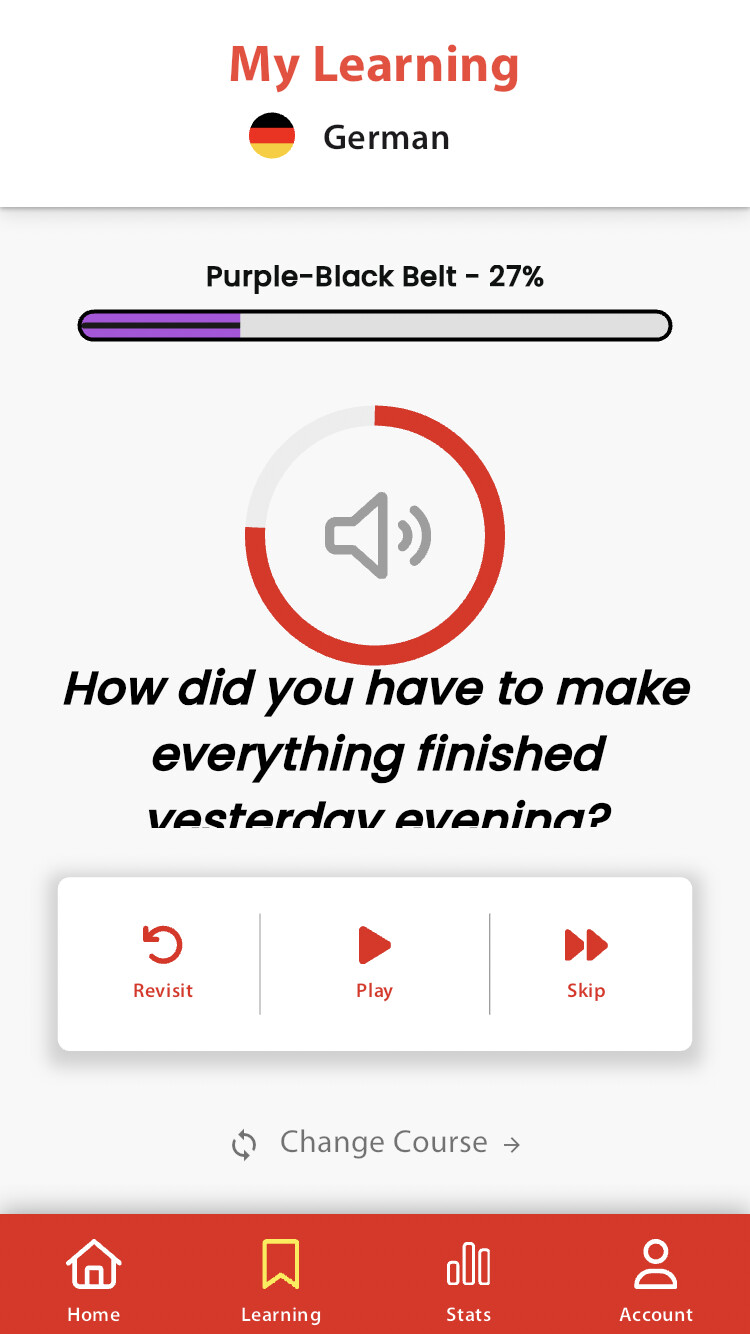
The male voice adds some extras to ‘kennst du die’ and doesn’t say ‘wollte’ on its own properly.
1 Like
‘Gesagt’ is intoduced as ‘say’ - wouldn’t it be ‘said’? And the female voice doesn’t say it clearly.
The female doesn’t say ‘dir etwas’ properly and it jumps when she says ‘es hat gesagt dass er dir etwas’ so part of its repeated.
The male voice doesn’t say ‘ja weil’ or ‘die Deutsch lernt’ properly and he adds some extras to ‘arbeiten’.
Sometimes there’s a gap in the male voice in the middle of ‘ich glaube dass sie nicht von zu Hause au___s arbeiten möchte’.
There’s a prompt for ‘she is’ with no German following.
The male voice doesn’t say ‘die drei und’ properly, ‘oder wie’ or ‘er anfängst’.
The female doesn’t say ‘nicht gerade’ properly and there’s a gap when she says ‘er sagte__dass er nicht konnte’.
I think there might be some confusion about ‘konnte/könnte’.. ‘She could lay it’ is ‘sie könnte..’ but ‘he could’ is ‘er konnte’ and ‘he couldn’t afford himself’ is ‘er konnte sich nich leisten’.
The male voice doesn’t say ‘dass er wollte’ properly twice, but then its OK. And he adds an extra bit to ‘er sagte dass er nicht alle fünf Spiele sehen konnte’ (and I can’t remember if the prompt for that was ‘can’t’ or ‘couldn’t’).
The female voice doesn’t say ‘sich nicht leisten’ properly.
(btw…there is now a slow scroll for longer sentences - or for larger font settings…this just caught my eye )
1 Like
Apologies if you were already aware of this and I misunderstood the problem, but English “could” has (at least) 2 meanings: past and conditional. German uses different forms for these 2 meanings. Does that answer the question or have I misunderstood?
Dunno… In the app, they seem to be using different forms for what appear to be the same meanings: konnte and könnte both to mean ‘could’ in very similar phrases. Its not clear what the difference is, so its confusing…
Well, let’s take the one about putting something somewhere. In English, it’s not very natural to use “I could” with past tense meaning in positive sentences like this. If you think about it, “She could put it on the table yesterday.” just doesn’t sound very natural. In positive sentences in the past tense, we tend to use “could” for general abilities like “I could swim when I was a kid.”
So regarding the sentence in the app, if it was the past meaning, we would expect the prompt to be “was able to lay” not “could lay” and so we can confidently expect that “could lay” here has the conditional meaning and predict the conditional form “könnte” in the answer. The meaning here is that she would be able to lay it somewhere rather than that she was able.
The other one about not being able to afford something is more ambiguous. If you think about it, “He couldn’t afford something” could, out of context, mean either that he wasn’t able to afford it or that he wouldn’t be able to afford it. Perhaps the full, longer sentence will make the context clear. If not, you’ll just have to remember that the app evidently means “was able” when it gives you this prompt.
- Note for completeness, German also uses “könnten” for subjunctive forms like “If I could…”. Don’t let that confuse you if you see it.
2 Likes