Diolch, Deborah. 
In the south course,
Well iddi = she’d better
Well iddo fe = he’d better
I just wondered why the fe bit for the masculine, but no hi bit for the feminine?
Diolch
It feels more comfortable I think. The hi isn’t strictly necessary, and it takes a little extra effort enunciating “-i hi” so that the syllables are distinct. Why bother?  Just plain iddo is fine too and is often used in formal writing, but in speech iddo fe rolls off the tongue nicely.
Thank you, since starting to learn, a year ago now! I have been aware of how some things sound or feel very pleasing. I get great pleasure just having a little chat to myself, using my favourites  .
.
3 Likes
I know that diflas means boring (as well as adjacent concepts like dull and miserable) but how do I express that I am bored? That tv show would bore you? The children have become bored? She is in a state of boredom?
There’s a verb “diflasu”. So “Byddai’r sioe teledu 'na dy ddiflasu”, “Mae’r plant wedi diflasu”…
2 Likes
Diolch!
1 Like
Related question - how would you say that food is ‘tasteless’ without saying that it’s boring? (Maybe you like bland food: maybe it’s the madeleines of your childhood for you.)
1 Like
You’d say it was di-flas. The hyphen makes all the difference (to both meaning and pronunciation!)
3 Likes
Oh, good. I reckon that’s more or less what I do say; and I’ve never had cause to write it, yet.
When it’s ‘for the benefit of’, i or ar gyfer would both be OK here, Verity. And generally (unless it’s for ‘in exchange for’, which is am) ar gyfer is a pretty safe neutral choice, and very common.
2 Likes
Not a grammar question (is that allowed?), but hopefully short and quick.
Does the name Dewi Stephen Jones mean anything to anyone, specifically as a poet? Been going through some of my taids old books and found an poetry anthology featuring Mr Jones, which also seems possibly to be a Christmas present to my taid from Mr Jones
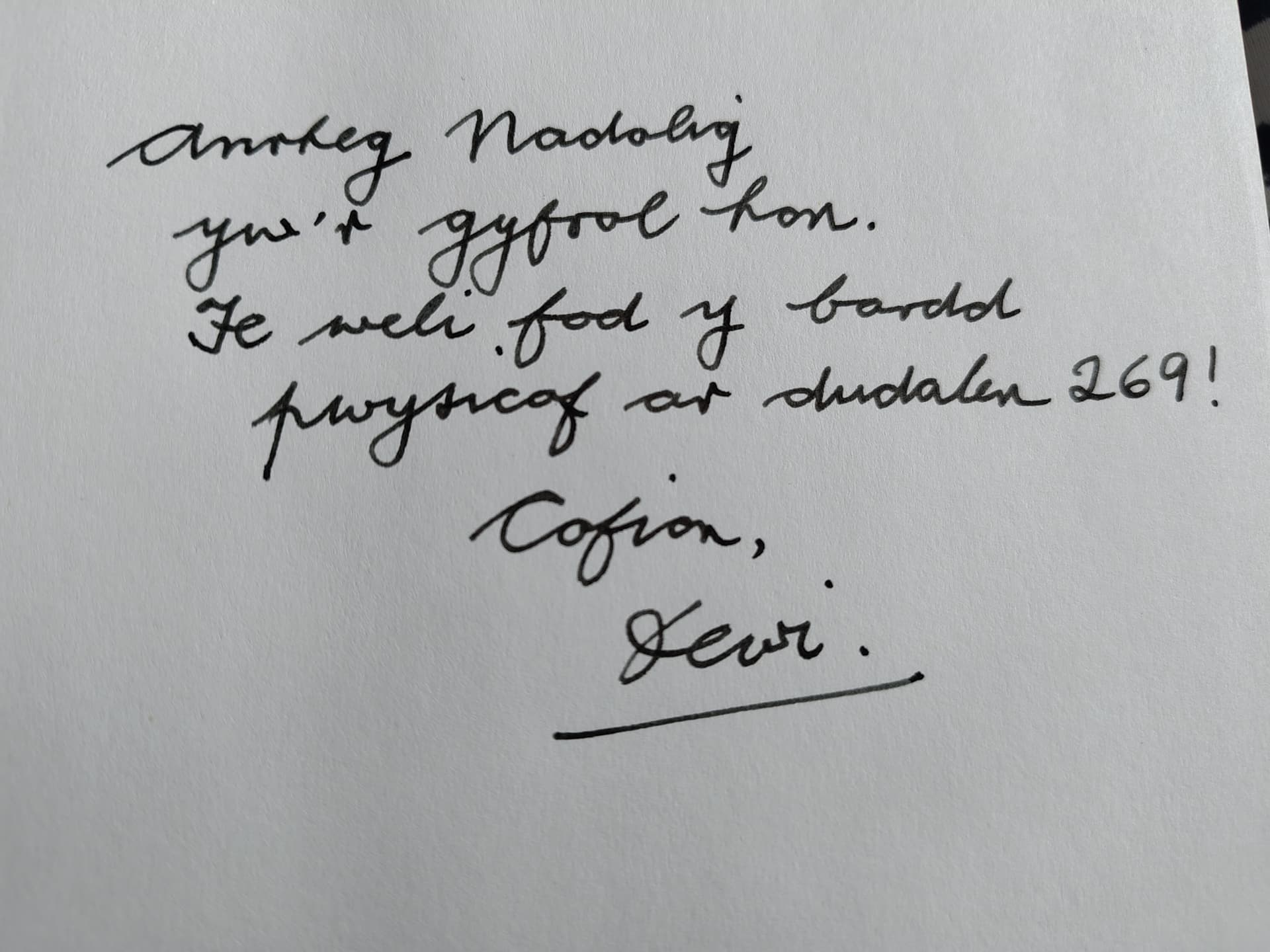
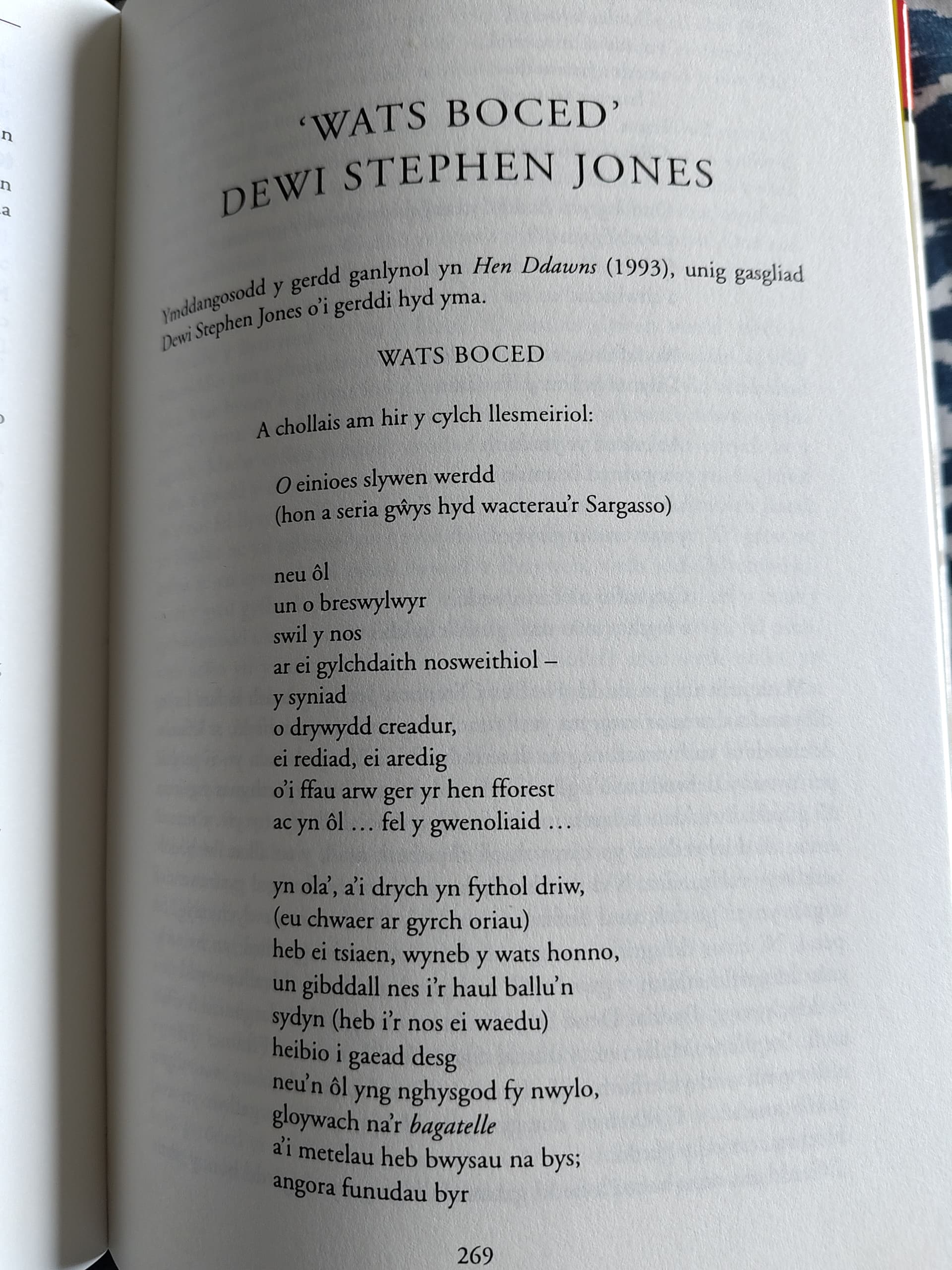
Found some info on the National Library of Wales site -
Yr oedd Dewi Stephen Jones yn fardd a beirniad a oedd yn hanu o’r Ponciau, Rhosllannerchrugog, ac yn fab i Stephen a Lottie Jones. Ganwyd ef yn 1940. Enillodd Wobr Griffith John Williams yn 1995 am ei gyfrol o farddoniaeth Hen ddawns (1993). Lluniodd ddwy astudiaeth ar farddoniaeth Bobi Jones yn y gyfres Llên y Llenor ac roedd yn cyfrannu’n gyson i gylchgrawn Barddas ac eraill. Cyhoeddwyd ei ail gyfrol o farddoniaeth Ffynhonau uchel yn 2012. Bu farw ar 14 Ionawr 2019.
Dewi Stephen Jones was a poet and critic who came from the Ponciau, Rhosllannerchrugog, and was the son of Stephen and Lottie Jones. He was born in 1940. He won the John Williams Griffith Award in 1995 for his volume of Old Dance poetry (1993). He compiled two studies on the poetry of Bobi Jones in the Llên y Llenor series and was a regular contributor to Barddas magazine and others. His second volume of high springs poetry was published in 2012. He died on 14 January 2019.
1 Like
Hi Siaron, thank you so much for this, I’d struggled to find much out so thats brilliant - I really appreciate the effort. Anyway found a few more of his books each with handwritten messages - turns out he wasn’t just my taids friend, but my taids nephew! I’ll have to see if my dad remembers him.
3 Likes
Would / Wouldn’t
Via SSi I’ve learned byddwn i / fyddwn i ddim, but looking at other books / writing / speaking I’ve also seen baswn i / faswn i ddim with some noting that it’s more common in speech whereas byddwn i is more formal.
Can someone knowledgable confirm which is better to use in speech please?
It’s really a case of personal/local preference as to which to use. If you’re in a Welsh speaking area, you could listen out for the one used most and go with that one. Or simply use the one you remember easiest. The ‘trick’ is to recognise both forms so that if you come across the one you don’t use, you’re not thrown by hearing it.
Ok thank you! 
1 Like
Hi All.
It’s nice to pop back in. I hope you are all Well
Anyway, am I remembering correctly that “Ymhen” (y pentref, or something) was used in the Southern Course to mean - at the end of the village?
I am aware that it can be used to denote the end/within a period of time, but I’m just checking if it’s ok to use Ymhen for a physical distance in this way.
Many thanks
John
Hi, there’s an update.
I have been reminded that “ymhen” is time related - ymhen penwythnos: within a fortnight.
“Ym mhen” is distance related. Ym mhen ochr y pentref. The other side of the village.
Do most people use ohono fi as in ‘mae llun ohono fi…’ or do I hear some people just saying ‘mae llun o fi…’ ?