Here nad yw e is the same as fod e ddim. It’s used a lot more in the southern course, pretty much anywhere where you could have fod e ddim regardless of what the ‘original thought’ might have been. It’s just an alternative way of joining a negative statement, often heard as nag yw e in spoken Welsh in the south.
1 Like
Thanks, Deborah. I think the Work Book makes the grammar appear more rigid than it is!
It’s like any language learning really - you are given the basic structure so you have something to grasp and build on, but in the real world there’s a lot more variation. That can’t all be explained in a single text.
I’ve come back to SSiW after a bit of a break and am enjoying refreshing my memory with the new app and the new voices for South Welsh. I learnt initially with Iestyn and Catrin, and some of the pronunciation is quite different now. I’ve got used to saying “sit” now where I was previously saying “should” for sut, but every time gwneud comes up it surprises me again. I’m expecting the w to sound like “uh” but instead it’s always “wuh”. At some point in my Welsh journey, I internalised the idea that “wuh” is more of an English sound and that w is more of a “uh” or “oo” in Welsh. I guess that’s wrong, but then I don’t know there I got that from? Any help would be great. Currently I am saying g-uh-nade and then muttering under my breath when they say g-wuh-nade!
I’ve completed the North course, still working through old stuff. I am now into the South course, it is lovely covering old ground and really testing me to learn the Southern things.
Gwybod pronounced gweebod blew my mind! But I love dy helpu di  .
.
1 Like
Some people in the south do pronounce it like that, especially when they’re speaking ‘carefully’, but if you go with what you learnt first of all, you’ll be fine. There are variations of Welsh pronunciation everywhere (like there are with English), so if you live in Wales, listen to what you hear around you and go with that.
You can also watch something like Pobol y Cwm on S4C and pick up the natural southern Welsh pronunciation from that.
1 Like
Ah good, I was hoping it would be an acceptable alternative, thank you! I couldn’t remember how Iestyn said it - one of those words I hadn’t really thought about till just recently.
1 Like
Can I have some help with this one please?
I thought that “speak to” was translated as “siarad â(g)”.
In this example it has been translated as “siarad gyda…”
I’m assuming from this that they are interchangeable?

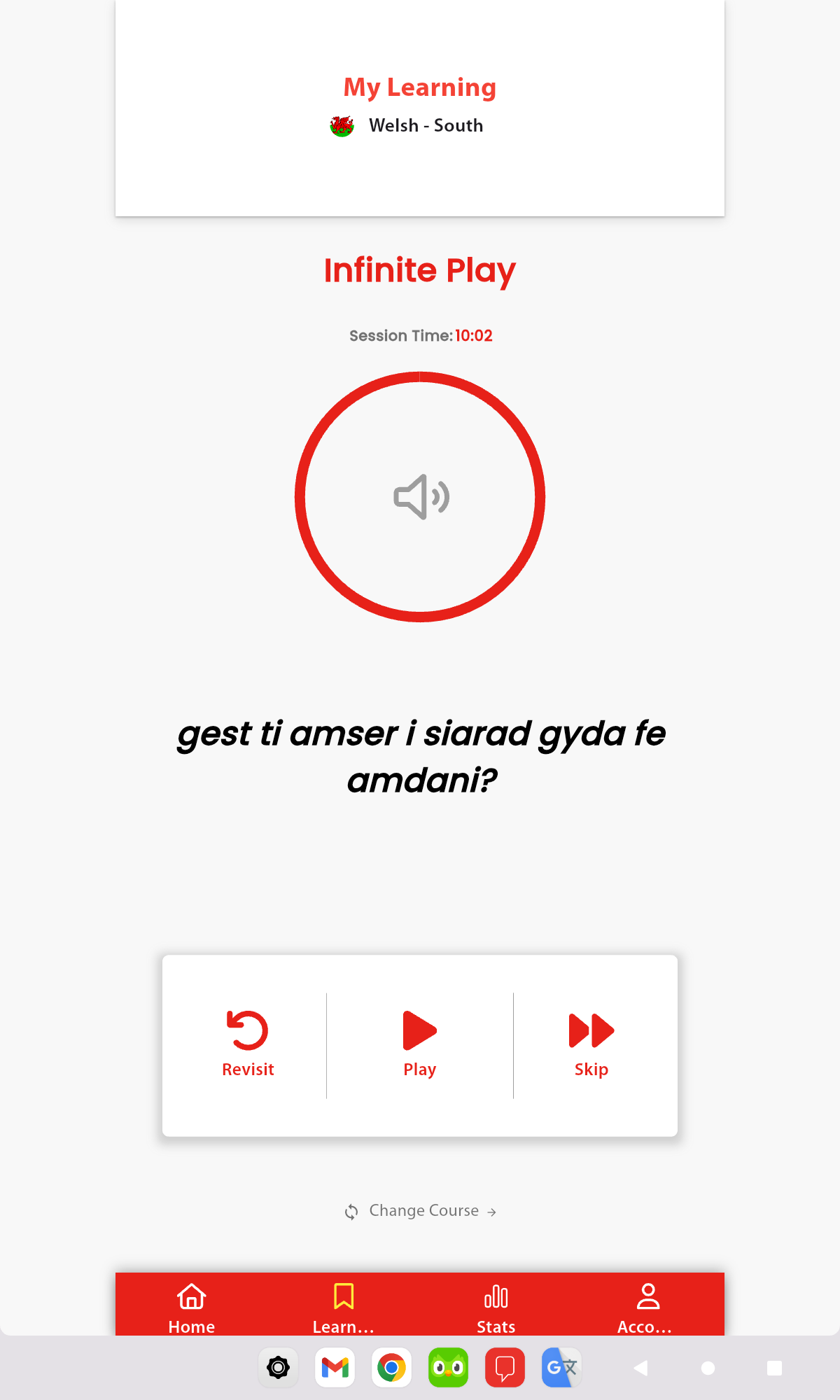
In English I feel there is a slight nuance, difference between ‘speaking to’ and ‘speaking with’. I usually use the former but totally understand the latter.
1 Like
Yes me too. I would have thought they would have said “talk with” if the translation is “gyda fe”.
In casual speech, where you might say “I’m going to talk to him about it” in English, you’ll hear “Dw i’n mynd i siarad gyda fe amdani” in Welsh. Grammar books will tell you it’s siarad â/ag but in everyday speech you’ll hear siarad gyda as well.
3 Likes
Thank you, that was something I didn’t know
Beginner’s question here. I have been using a range of resources to try and study Welsh remotely, including Duolingo, reading Gareth King’s incomparable Modern Welsh, browsing online discussion threads (like this forum, the Dysgu Cymraeg FB page, Reddit’s r/learnwelsh), working my way through the podcast Cymraeg Bob Dydd; and most recently starting on SSi (North). A fabulous smorgasbord of language learning, but awash in grammatical variants. Most of the time I think I’ve been able to triangulate and figure out which versions are simply more formal or more colloquial or even slang, which are regional variants etc, but there’s one that’s really been puzzling me, and I’m hoping someone here can give me an authoritative answer.
So here’s my newbie’s question: when asking questions with adverbial interrogatives like pryd or ble or sut, should one use rwyt ti or wyt ti? Mae or ydy? Is the latter more ‘standard’ / correct? Is this a regional difference? Cymraeg Bob Dydd teaches ‘Ble rwyt ti’n byw?’, Duolingo uses ‘ble rwyt ti’n mynd wedyn?’ and ‘am faint o’r gloch mae’r bws yn cyrraeg?’ and several discussion threads agree that these are the more correct form with adverbial question words (but NOT beth, pwy, faint). But there’s no mention of this in Gareth King, and it’s not what is taught on SSi, both of which are pretty authoritative. I’m trying to acquire a spoken Welsh that leans ‘correct’ more than fun and casual — at my age, it seems more appropriate — but I don’t want to use forms that will sound stilted, or are just plain wrong! Can anyone set me straight?
rwyt ti and wyt ti are equally usable, so for questions directed at a single individual you can use either - it’s a matter of personal/regional preference. Use whichever gets to your tongue first!
Some adverbial question words do use ydy, but pryd, ble and sut are ones that are always accompanied by mae, so for questions asking when, where, or how about a third person/object, use mae.
Hope that helps.
This is certainly true, Susan - and I suppose is an inevitable consequence of the fact that Welsh often has a range of variations, and one simply doesn’t have space to accommodate all of them. I think I may have included a little get-out clause to that effect in the Introduction to those books. 
1 Like
I don’t know if my eyes are deceiving me, but I think I’ve seen “falle” (perhaps, maybe) followed by “bod” sometimes and not others. Is it optional? If not, I can’t work out when it used and when not.
Thanks
You do indeed see (for example) both Falle bod hi’n sâl and Falle mae hi’n sâl, Nigel - but the bod option is better style and to many sounds better. Same is true with Pam, by the way.
5 Likes
Thank you!! This forum is such an astonishing resource for the baffled beginner. Can’t express my gratitude enough.
3 Likes
I know there are so many questions and answers already on the forum to do with prepositions but I can’t find this one: if someone is raising money, say for the RNLI or Cancer Research, which preposition roughly mapping to “for” is best? I’m guessing either ar gyfer “for the sake of” or dros “in support of” but I’m not confident.
I would use ar gyfer in that situation
1 Like