You might see these markers used in novels (or I have) within quoted speech (even if they aren’t as common in real speech). They confuse me because I always want to read it as though the “mi” means the subject of the sentence i.e. English “me” (or rather “I”), when more often than not it is a third person (“he” “she” or a person’s name) that is the subject of the sentence. I try to force myself just to ignore them since they don’t seem to add anything, but mostly, they serve as a distraction (to me).
Just checked, and Bethan Gwanas uses them in narrative as well as (perhaps even more than) in quoted speech. Just got a book by Nia Medi who is said to be a similar kind of writer, and she seems to use them as well. However, on a quick scan, Fflur Dafydd doesn’t seem to use them. Maybe it’s a matter of style. Gareth King says somewhere that modern writing has been influenced by speech and that might be why it is seen in writing sometimes. He also says that in some situations they can be used for emphasis, but I think he means in the spoken language.
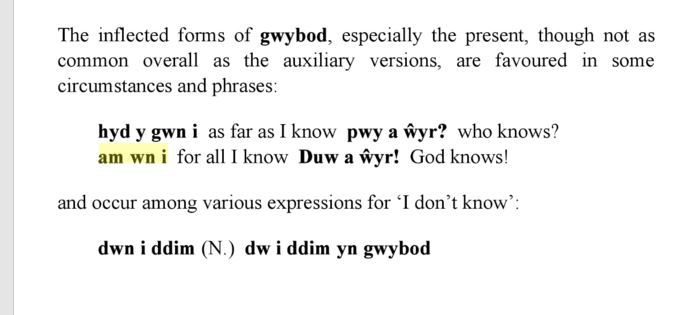
@hendraig: I think I heard Vince say recently “Am wn i” which I think is a set expression meaning “As far as I know”. ,found a reference in Gareth King Intermediate Grammar on Google Books…screen capture as I can’t copy and paste from there:
Vince is a good source of expressions: I got “go brin” from him a while ago. (“hardly…” in the context he was using it, anyway. May be used in other ways elsewhere, am wn i. )
I think I do occasionally hear the “mi” used in Rownd a Rownd, or at least have seen it in the Welsh subtitles.
I would say it’s best not to think of it as a “writing” versus “spoken” thing, they just blend into one another depending on the writer and the type of writing- like all aspects of Welsh. I’ve always thought that this “stressing written Welsh is a ‘different language’ thing” is actually quite unhelpful to people learning the language, but there we are. Just thinking of them as things which can or can not appear, and can or can not leave soft mutation in Welsh would- in my opinion, for what little that is worth!- be the best way to think about them.
Incidentally, they do come from the time when it would be “mi” in the first person, “fe” in the third and all the others similarly. Ie, the person could come in front of the verb. But they gradually lost that meaning and just became affirmative markers, with only “mi” and “fe” being used (perhaps because they were the most common?). If that helps you to get used to them at all!
“Wn I ddim” is, as I’m sure @henddraig knows, one of those phrases that everybody seems to remember from their school Welsh! (of course, something like “sa i’n gwybod” or " nagwi’n gwybod" would be more heard round here, but it’s one of those shibboleths that everyone seems to remember!)
“Gwn i” is simply the form that “gwybod” takes in that form to say “I know”.
So the answer to your questions is yes
Well, it’s definitely “coed y Cadno” - there were enough "cwrt y cadno"s etc about for me to be familiar with that even before I started learning Welsh properly! - so presumably “Coed y Cadno glas”.
[Ie, “Cadno” is masculine, so no soft mutation of “Cadno” after “y”, or of “glas” after “Cadno”. Presumably. ]
I honestly wasn’t sure it was that long ago, but it was something that I seemed to know for ever, but never met now!! Diolch!!
Now, @aran After Challenge 1.12 south, there is mention of a test. I doubt if I’ll do it, but I did think I’d read about it, but I can’t find the ‘Ask’ to click on!!
That sounds like the assessment thing @iestyn was working on with Agored - I’m not sure what the status is of that now, but when he next gets a chance to be on the forum I’m sure Iestyn will be able to let you know
Diolch!! I have noticed that, if ever I ask you, it turns out I should have asked @Iestyn and vise versa! Mainly, I just mention both of you!!!
p.s. I found the ‘Assessment’ heading. I will not bother! Photos of me are not something I like and my IDs are all out of date anyway!! Shame it isn’t possible to take the test informally, or test oneself informally, just as a guide to progress!!
is ‘am’ simply a short form of ‘amdani’? I ask because I’m often saying ‘amdani’ when Aran and Catrin say ‘am’.
For example to say “He is thinking about playing on Saturday” Could be “Mae o’n meddwl amdano chwarae Dydd Sadwrn” or “Mae o’n meddwl am chwarae Dydd Sadwrn”
Sort of, but not quite - they conjugate - so about Catrin, am Catrin, about the thing, am y peth, about her, amdani hi, about them, amdanyn nhw, and so on…
But it’s not uncommon to hear about people using ‘amdani’ instead of ‘am’…
Found an interesting related (I think) usage in “Atyniad” by Fflur Dafydd (not the easiest of books it turns out…), quoted colloquial (very) speech:
"‘Pa fath o betha wʼt ti’n sgrifennu ʼta?” meddai Cadi. ‘Be ma dy nofela di amdan?”
“What sort of things are you writing then?” said Cadi. “What is your novel about?”
[p41]
Not just a missing pronoun, but also without the expected “i” or “o” ending.
Now, this is logical in one sense, if the thing being written about is unknown and therefore the gender is unknown. But I thought indeterminate gender word were usually referred to in the feminine, which should suggest “amdani” shouldn’t it?
Sorry, is this question aimed at Aran? Not sure if the “reply” thing comes up on the first reply on this form of website, as it were. If not-
“Am” uses the compound “am+dan” for personal forms, but the compound “amdan”/“am dan” stands on its own as an undeclined form.
But really, probably just “they said ‘amdan’” rather than thinking of it like the above. Really something I wouldn’t try to work out to it’s basics. Anyone using it wouldn’t be looking for or thinking about a grammatical justification
Just read it and roll with it
“? eich plant chi ydy rheina ar y teledu?” - 'Are those your children on the telly?"
Aran and Catrin use a word at the beginning of this question, what is it? it sounds to me like ‘ei’ but this makes no sense to me, I assume it’s like ‘Are’ in English for a question?
“Ai eich plant ydy rheini ar y teledu?”
Sort of- Is it your children who are on the television?
(This isn’t a literal translation (literal translations very rarely, if ever, exist . “Ai” certainly should not be looked on as a literal translation of “is it” )
“Ai” is a ‘question marker’ in this sort of sentence.
It’s not a verb like “are”, it’s just used in this sort of sentence. “Ydy”, as you probably know by the looks of it, is the verb.
(But I haven’t listened to the lesson, just going by what you are saying .
Thank you! I get it, it’s a question marker, rather than literally ‘is it’. your translation makes sense, it is in a different word order to how Aran framed the sentence in English.
Indeed! There will be multiple ways of translating most (all!) sentences equally well. It’s best to look on them as translations of the meaning rather than translations of the individual words
Literally (bad thing!) it’s something like
Ai(question marker) your children are those on the television?
Ie “Are those your children on the television?”
 )
)
 - so presumably “Coed y Cadno glas”.


 ) sentences equally well. It’s best to look on them as translations of the meaning rather than translations of the individual words