That’s funny but a great idea. Jeeves for the most formal register!
2 Likes
Hi @Deborah-SSi . Sorry about the slow reply - I had a crazy week and havd only just been able to look at the app again. You are right - it’s definitely the new version: new model voices and everything. It’s taken ALL my languages right back to white belt, but it looks as if I can move myself forward as well as back, so fingers crossed I should be able to find a comfortable spot from where to pick things up again. Thanks!
1 Like
Hiya @Deborah-SSi, @Kai. Two minor comments on the new app.
First, congratulations on getting the female voicd to use feminine endings on adjectives. We talked about this way back ehen and I know it was going to be quite a challenge. So thank you.
Secondly, I don’t know if it’s just me, but I am finding that, very often, the new prompt voice is clipping the beginning of her prompts. So (for example) I can’t tell if she’s saying I speak, you speak, they speak… Read and need are hard to tell apart. And sometimes whole first words are lost.
If no one else has mentioned this, it must be just me.
2 Likes
Are you using bluetooth headphones? I have this problem with my current headphones. If I switch to an older set of bluetooth headphones or to non-bluetooth headphones, the problem disappears.
3 Likes
It’s not something that’s happening on my phone. Does Martin’s suggestion help?
2 Likes
The problem is I’m usually using SSi when I’m walking my dog, so bluetooth is really my only option. But I will experiment at home to see what hsppens when I don’t use them. Thanks
3 Likes
The obvious solution is to get a t-shirt printed:
Yes, I am learning Italian in public and no, I’m not using headphones. Problem? 
4 Likes

Just to let guys you know that there is a whole boatload of different of sentences at the end of the green belt (about 95%) where the male voice does not pronounce “amici” correctly.
2 Likes
thank you!
2 Likes
Hi , I’m at the beginning of black blue belt. When " something else" is introduced, the voices say " altro". but the subtitles are " qualcos’ altro ". The same happens in all sentences, like : play something else, voices : suonare altro, subtitle: suonare qualcos’ altro.
2 Likes
tagging @Kai 
looking into it, grazie!!
1 Like
Hi @Kai,
I’m still at blue black belt, about 90%,
The prompt ist: Those people said, the answer (voices and Text) is : quelle persone hai detto. Can “hai” be correct here?
1 Like
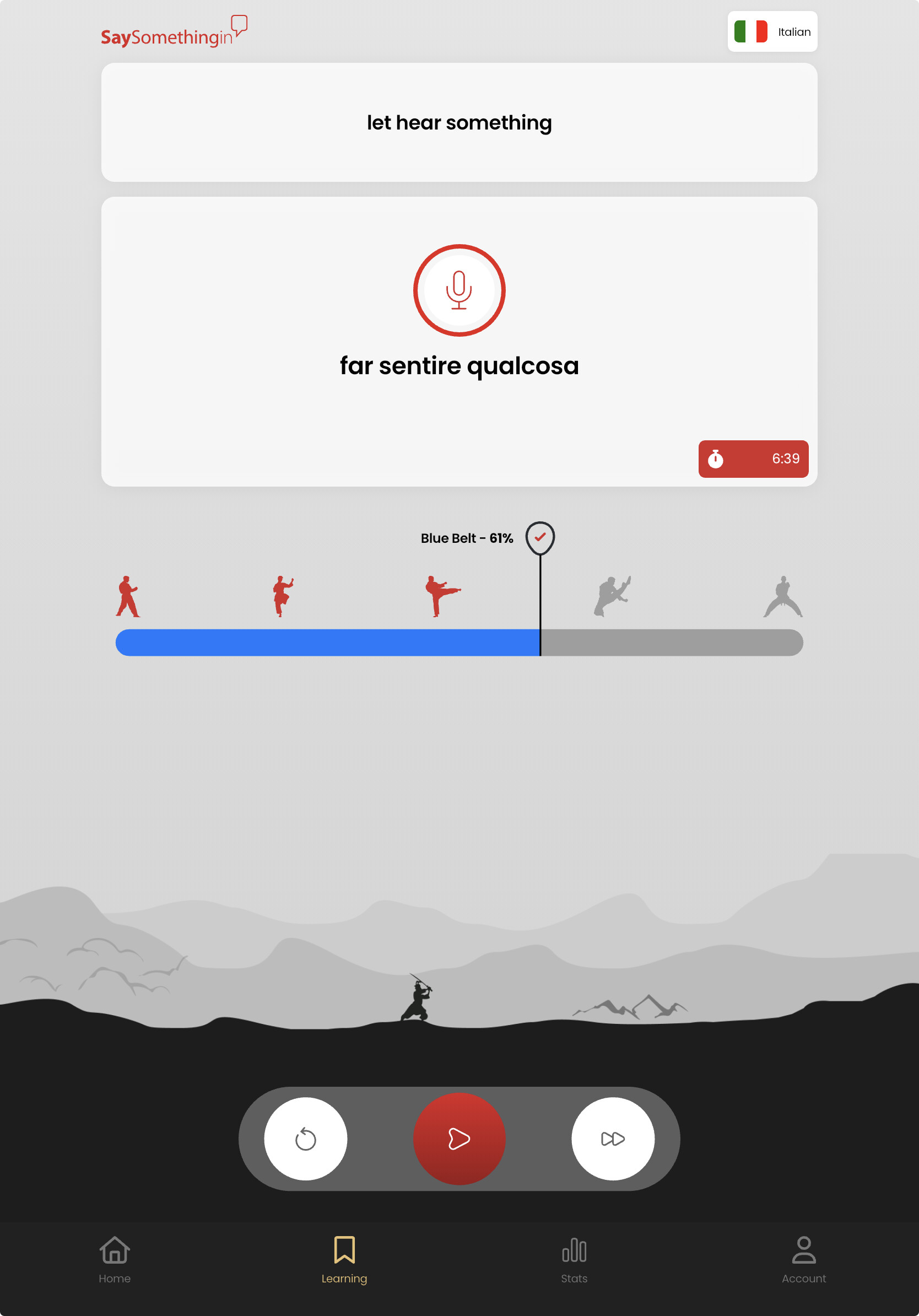
I’m not sure the English for this makes much sense, “let hear something”? And looking up far sentire, it is being translated to “to make (something) heard” or “to make (someone) feel”. Possibly something funky going on?
1 Like
Similar for this:
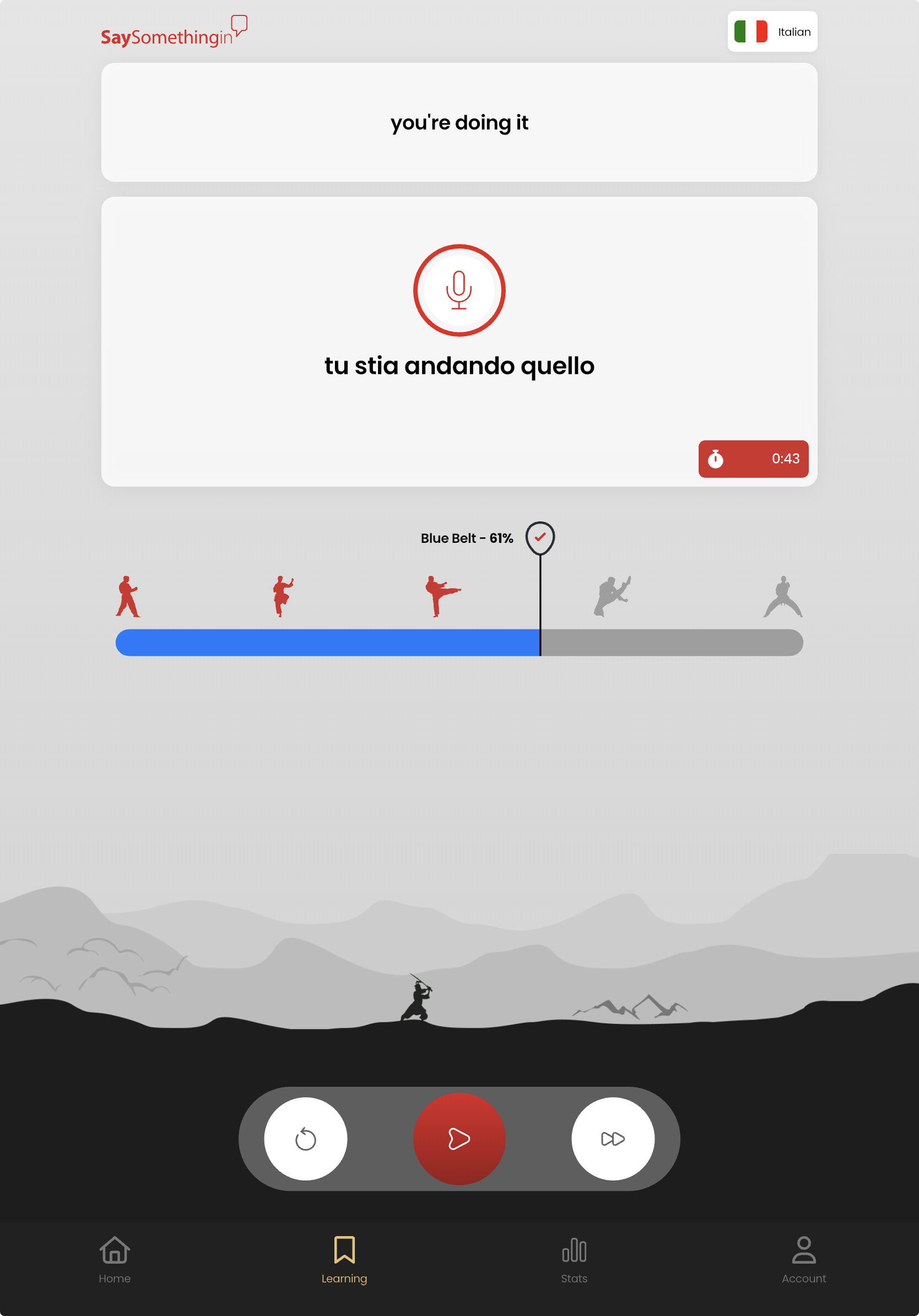
The similarity of andando to andare made me question it, and Claude seems to think it intends to mean either stai andando for “you are going” or stia facendo, for you are doing.
Also, doesnt quello mean that not it?
Obviously i don’t know but thought i’d flag?
1 Like
Thanks very much for flagging these! I’ll draw @Kai 's attention
AFAIK (and I’m just a learner like you), I think the Italian makes sense (as much sense as an incomplete fragment can).
At the moment, the AI is essentially trying to translate an incomplete fragment in Italian into a fragment in English, which I imagine is probably not really what it’s designed for. It’s actually encouraging that it warped the English rather than the target language.
If what I think is correct, then there will be a better translation once there is a longer chunk with more context for the AI to work with. I imagine it might end up being a passive in English (something like “let something be heard”).
1 Like
This one is a bit different, as I don’t think the Italian makes much sense, even as a fragment.
In the old Italian course, they used “ti sta andando bene” in the context of “you’re doing well” (lit: it’s going well to you). That might explain the verb choice, depending on what the full sentence ends up being. Even with that, though, the Italian still doesn’t make much sense.
I’ve noticed that sometimes the AI will jam two fragments together into what looks like 1 (nonsensical) fragment, which might explain the “quello” part tacked on at the end; but even that wouldn’t explain the “tu” (I would expect “ti”). With “tu”, it just seems to mean “you are going” with a nonsensical “quello” tacked on at the end.
Genuinely, I’d be really interested to know what the full sentences (the Italian one and the English translation) end up being. For the reasons above and also out of curiosity regarding why the subjunctive is being used.
Finally, I’m just a learner like you, so take my judgements on the Italian with a pinch of salt unless and until they are confirmed or corrected by @Kai or @gisella-albertini.
2 Likes
since @martin-harte tagged me, here’s my point of view.
far sentire qualcosa - by itself it can be translated in more than one way and it’s impossible to know now where this is going without a context.
As is, I’d probably think first of “to make (someone) feel (something)” as Jack said.
Or in different situations, it means “to hear”:
“smetti di parlare e fammi sentire cosa dice Antonio!” - “stop talking and let me hear what Antonio is saying”
“alza il volume, fammi sentire le notizie” - “turn the volume up, let me hear the news”
However to me personally, it reminds first of all of when I’d spend my Saturdays afternoons after school in record shops. The owners or older clients would use it all the time:
“ti faccio sentire qualcosa che secondo me ti piacerà”
“ti faccio sentire qualcosa che devi assolutamente conoscere”
“ti faccio sentire qualcosa di nuovo, arrivato proprio ieri”
“falle sentire un po’ di vero rock’n’roll!”
Or myself:
“mi fai sentire il secondo pezzo di questo album?”
Right away I don’t know what would be the best translation in English, literally “make (someone) hear something” or “let (someone) hear something” but we just really use “hear” instead of “listen” here.
3 Likes