Backstory of how Ireland ended up with a population of native speakers of only about 80000 people. During An Gorta Mór (1845—1852) already poor people from rural areas who predominantly depended on potato crops because they had very little land to work on disproportionately suffered from potato blight. Rural areas were also areas populated by Irish-speakers. British government didn’t stop importing food from Ireland despite food shortage. Relief effort was quite limited too, because British government was into “survival of the fittest”, they figured it’s okay if excessive population dies out “naturally” and in any case giving too much help would probably only encourage people to be lazy. Logically, there was mass immigration from rural areas, folk decided it would be more practical to leave homeland than die from hunger. This way Ireland lost about 1,5 million native speakers to hunger deaths and immigration. This collective trauma strongly linked speaking Irish to being poor and in danger and discouraged Irish-speaking parents from passing on their language. Those who stayed willingly complied with “no speaking Irish” policies and punished kids for speaking Irish, figuring they will be better off as English-speakers and the language is not worth living in poverty.
When Ireland became independent, there was a question of how to revive the language that was barely breathing at that point. Irish government decided to make language transmission entirely school-based (and there was some logic to it, because government can directly control schools but not families). Gaeltacht areas were kept as linguistic reservations where kids can go on vacations to try and speak some Irish (if their families can afford it), but most of the actual teaching was done by L2 speakers, who often were not fluent themselves (hence anglicized syntax and pronunciation of school Irish - school teachers did their best). Naturally, several generations of L2 teaching L2 later while L1 population stays segregated, differences accumulated.
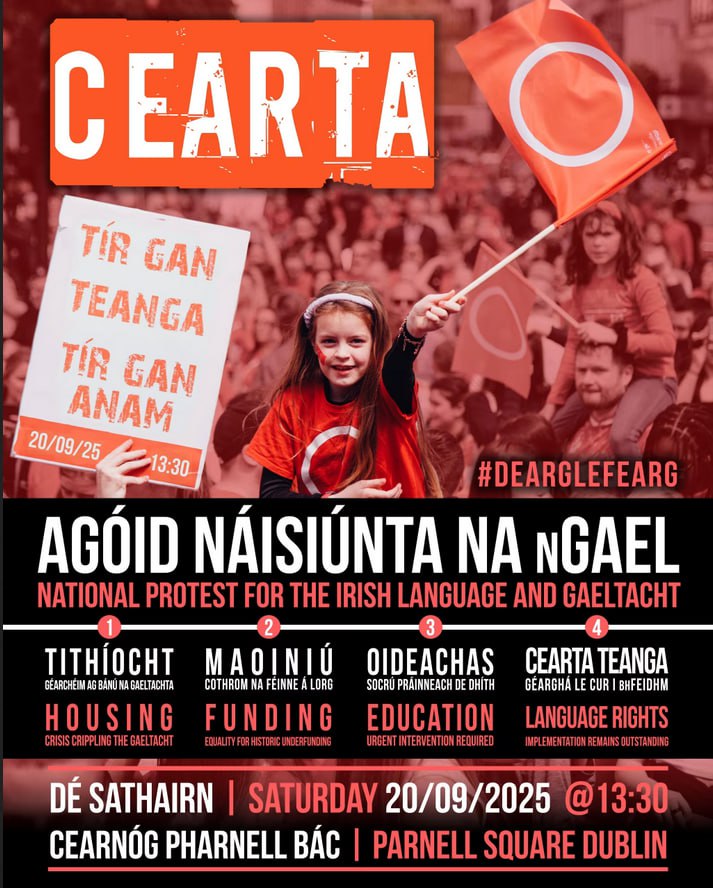
Gaeltacht population was quietly de-prioritized and slowly drifted into the housing crisis that was a logical consequence of visitors’ traffic. Current wave of Russian immigrants did pretty much the same to destination countries: when landlords can earn more on newcomers, housing becomes unaffordable for locals. As a result at this point in history (2022 survey data) only about 15% of families living in Gaeltacht areas raise their children in Irish, the idea stays pretty much the same: kids will probably be better off as English speakers. Which is very logical, if they won’t be able to afford a place of their own in Gaeltacht anyway.
That’s a bilingual flyer from last year’s protest action - housing issue is listed first (tír gan teanga - tír gan anam means a land without a language is a land without a soul).

 ) but I’ll look into it and pass information to the Tech Team.