I think that aún was taught in the previous iteration of the Spanish course, but I haven’t heard it at all in this one.
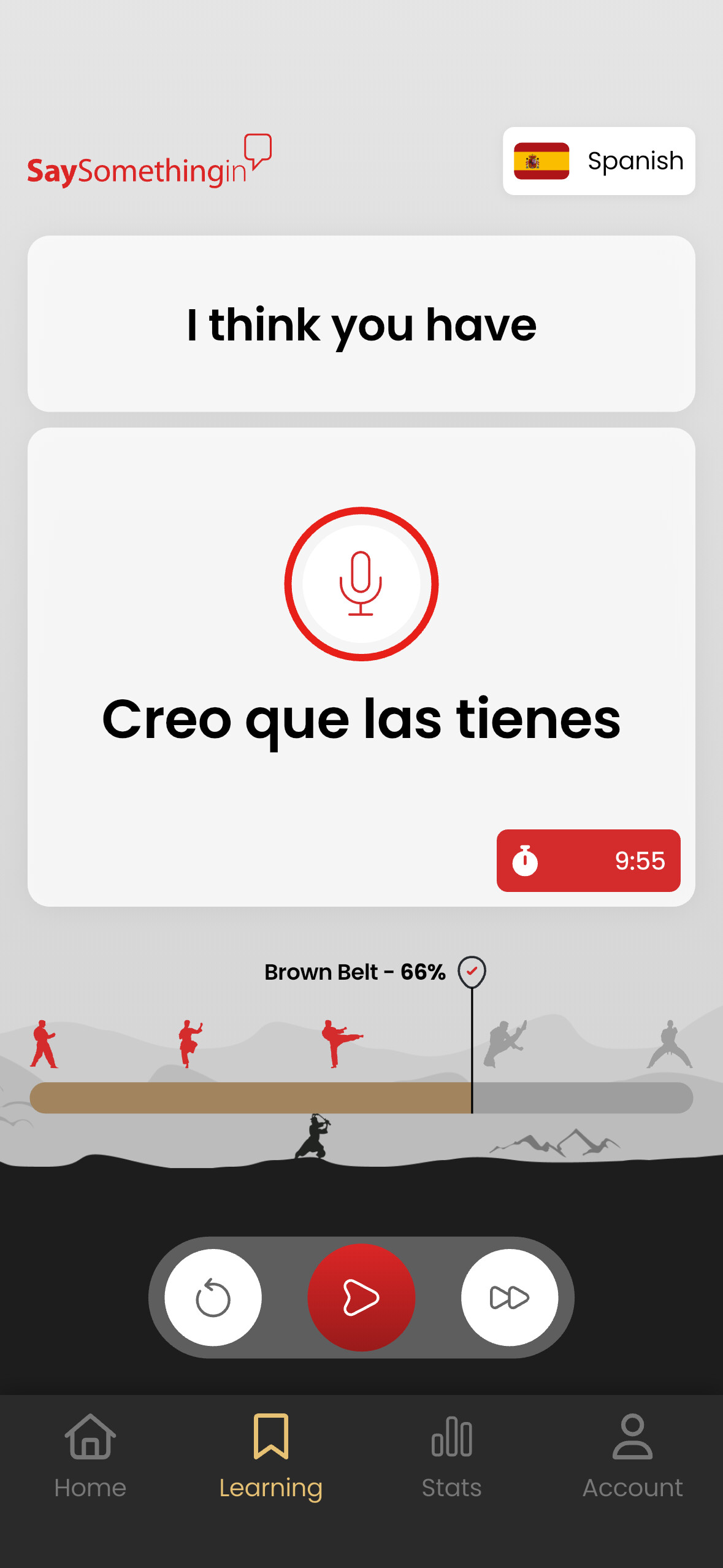
I believe that you have… ( plural)
Pero no estoy seguro 
1 Like
I would just keep going TBH. I’d bet quite a lot that it’s part of a longer phrase that has been decomposed into parts slightly differently in the Spanish and the English and that the next word in that longer English phrase will be “them”.
More speculatively, I wonder if whatever algorithm they use to decompose longer sentences into smaller chunks looks for the same word in English and Spanish to use as an edge. I’m just guessing here, but if that was the case, it would guarantee this outcome, as Spanish object pronouns obligatorily precede the verb and English ones obligatorily follow it.
But even if that second paragraph is way off, I’m pretty confident the first one is correct, so just keep going and it will sort itself out.
1 Like
I did, and it did 
3 Likes
I’m glad it resolved itself  but a general point with Spanish is that it doesn’t like not having an object of some sort for a verb that needs an object, e.g. you can’t just “have”, you have to “have something”, so there is a tendency to stick a lo or las or los in as a substitute object until it’s clear what you’re talking about.
2 Likes
Creo los tienes mis cervezas 


I think what you’re trying to say is creo que tienes mis cervezas or perhaps ¡Ojo! ¡Esas cervezas son mías! 
1 Like
Wow! Dos años ya! Felicitaciones! @Alan-Clifford 
1 Like
Gracias 
1 Like
Hola
When learning Cymraeg i was encouraged to overpronounce or roll my R’s. And to native speakers it would be relatively normal. Not sure if thats true or not. But it seemed to work. As over pronunciations will gradually and naturally resolve and settle down. I am wondering would this be the same thing in Spainish with R,s and moreso or differently with double R’s.
Muchas Gracias
Well, to be honest, I don’t really hear people rolling their 'r’s in an obvious way, though if they’re distinguishing between perro and pero it’s a bit more noticeable.
The only time I’ve heard someone really doing it was a friend of my housemate’s when he was on the phone. He really over-emphasised the rolling r’s, but especially on the ends of words. It was quite funny, and my housemate used to look at him with raised eyebrows as if to say “Why on earth are you talking like that?”. He sometimes sings in the streets as a busker and he does it when he speaks through the microphone, and when he’s singing, so obviously in situations where he feels he needs to be clearer in his enunciation.
But, in general conversation it doesn’t matter a lot. In context, people will know what the word is and will hear it the ‘r’ as rolled whether you do it or not.
1 Like
Buenos días mis amigos
On Orange Black belt the phrases
“I were nearly ready” and and few similar constructions which sounds odd.
Estuviero casi preparado.
Is this basically. I was nearly ready?
Gracias
1 Like
I believe it’s a literal translation of the subjunctive mood;
Easy Examples of the Subjunctive Mood
- If it were me, I’d go.
(As this explores a hypothetical situation, “was” becomes “were.”)* I wish it were real.
(As this expresses a wish, “was” becomes “were.”)* It is imperative that the game begin at once.
(As this expresses a demand, “begins” becomes “begin.”)* I propose he work full time.
(As this expresses a suggestion, “works” becomes “work.”)
There was some amount of discussion about this around the Ultavox record “If I was” as it should have been “If I were”
2 Likes
I love the subjunctive mood in English, sad that it’s slowly dropping out of common use.
1 Like