I have heard the diphthong ‘ei’ be pronounced as the standard Welsh ‘ay’ sound and as a dialectal ‘eye’ sound from the South. So the word teithio can sound like (t-eye-fio) or (t-ay-fio).
What is confusing me about this usage is that the ‘ay’ pronunciation is apparently for native speakers, and the ‘eye’ pronunciation is for second language learners / non-native speakers.
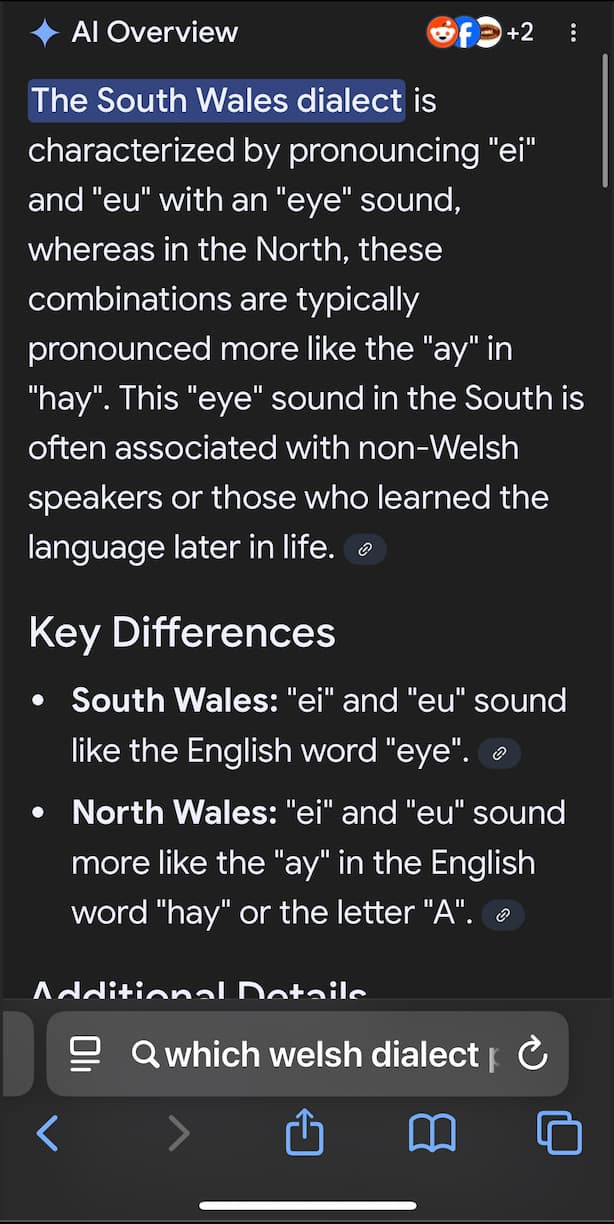
As a knock-on effect, Google’s AI system affirms this distinction presumably because of this Reddit post (see the attached screenshots of the AI response of when ‘ei’ is pronounced as an ‘eye’ sound).
So, is this distinction true between native and non-native speakers? If anyone confirms this as true, can you provide some sources where this distinction is direct and apparent?
If this distinction is untrue, then this information is potentially damaging to the whole Welsh speaking community by evoking an ‘us vs them’ approach between natives and learners.
From my personal experiences, I studied B1 Welsh with a Swansea provider, and many learners used the ‘ai’ pronunciation for the diphthong ‘ei’.
However, my cariad who knows Welsh and was born and bred in South West Wales, also pronounces the diphthong ‘ei’ as an ‘eye’ sound as other natives around the area naturally do the same.
I’m inclined to believe this native/non-native explanation is a crock of nonsense (to put it politely). But I want these speculations to be finally laid to rest. I can’t imagine a North Welsh speaker using an ‘eye’ pronunciation just because they are not a native speaker. Seems very bizarre to me.
I’ve only heard teithio pronounced [t-ay-thio] but I’ve heard variations with the single word ei. In natural speech, it’s more like [ee] e.g. ei dad e [ee dad e], but when speaking more formally or “correctly” it sounds more like [ay] or [eye] depending on the person. I think the main things affecting how new Welsh speakers say it are whether they had a tutor who encouraged “natural” pronunciation, and whether they live in a Welsh-speaking area and mix with first language speakers.
I think it’s even more complicated that than. There is I believe a concept of “standard” pronunciation (where you pronounce every letter as it is presented) distinct from “regional” pronunciation. This most clearly seen in the final phoneme -au (which is pronunced -a in the north, and -e in the south, but as it is written in “standard” pronunciation). Unfortunately, there is no such thing as “standard” spoken Welsh - it such a thing is often referred to but I have yet to find an actual source that standardises it (and I have tried, believe me…)
So many people still cling to this concept of “standard spoken Welsh”, in the belief that it is a form that transcends regional variation (as does Standard English, for example). The result of this is exactly as you describe - a form of speaking that is stigmatised by many “natural” Welsh speakers. (And I think I’m right in saying that the need to try to avoid this was part of what fed into the revision of the Welsh for Adults curriculum back in 2011-ish, where a more regional colloquial approach was taken than had previously been the case.)
Having said all that, I believe that is changing. I read an academic study (which I will go to dig out when I have more time in a few weeks, if you’re still interested) that suggests that now most young people acquire Welsh at school rather than in the home, elements like this are in fact becoming standardised. Basically, more young people are speaking like this rather than with the accents they hear around them.
I realise this isn’t laying anything to rest - sorry!
Speaking as an erstwhile in-comer I find that the “eye/igh” pronunciation tends to be used in the company of English speakers, while “ay as in hay” tends to be more Cymraeg. However, some words such as “eithin” just use the “ee” pronunciation without a thought - even for English speakers especially in place names. Also in words like gobeithio (gobeetho). Regarding the pronouns, our tutor has told us to go straight for the “ee” sound as he mentions that they were all changed on paper from the commom “i” to ei, eu, etc at some time in the past to accentuate the gramatical person (his, ours etc), leading to people pronouncing the words in a hypercorrective matching fashion. So he advises us just to go straight to “i” (ee).