Not that much I’m afraid - English isn’t my first (or even second) language. My very theory-oriented school taught me the principles of reading Latin aloud, but not much else 
1 Like
Well, amend that to “in your native language” then. 
Do you ever read aloud to any children? That’s also good training.
Basically, you need to enunciate very clearly, and also try to sound natural. Put expression into your voice that matches the meaning of the words. Stick to the rhythm of the poem (one advantage of Welsh poetry is that the rhythm is impossible to miss, IMHO). It’s getting the balance right between the poem’s meter and a naturalistic, expressive “flow” that’s the trick. Neither should ever be wholly sacrificed for the other.
Breathing is also important - never ever take a breath in the middle of a line or phrase. You’ll hear that in singing lessons too, for the same reason. Projecting your voice shouldn’t be much of an issue if you’re recording with a microphone, but you still want to be relaxed and use your diaphragm. The voice gets strained and odd-sounding if you’re tense and “breathing with your shoulders”.
Source: several years of childhood spent reciting poems for Speech and Drama competitions and exams. It was a long time ago and none of it was done in Welsh though!
And hey, the point of this challenge is not artistic perfection. It’s just to speak some lovely literary Welsh aloud. Some of us (me) are too chicken to do it. Considering the number of years I spent doing exactly this, it’s a little weird I’m so leery of performing or being recorded, but there we are. People are complicated.
1 Like
That is a very elaborate reply, thank you 
Actually, my question was more about “rules of Welsh poetry meter”, because I can guarantee you that I can miss the rhythm in a Welsh poem but your advice was very helpful in a way I didn’t even think of yet. Diolch o galon!
I’m really not an “out aloud” person, but with your help and the imaginary Aran in my head saying that “you are MEANT to make mistakes”, I guess I’ll just have to make the recording one of these days 
1 Like
My brief question for today.
I’ve seen and heard “up” and “down” expressed as “i lan” and “i lawr” elsewhere. I was in a lift the other day and the invisible voice used those terms. In the examples SSIW uses, the ‘i’ is dropped. E.g. “mynd lan y wal”. Am I missing something here?
Thanks
My S.Welsh is a bit rusty, but I think lan is used on it’s own whereas lawr (and fyny for ‘up’ in the North) need the i (happy to be corrected if I’ve mis-remembered)
“dwi’n mynd lan i’r Gogledd” / “dwi’n mynd i fyny i’r Gogledd” / Dwi’n mynd i lawr i’r De"
With lawr the “i” is optional. Dw i’n mynd lawr i’r parc (I’m going down to the park) or Dere lawr nawr! (Come down now!) are fine
2 Likes
Posted this for interest. I often try talk to the checkout lady in Swansea’s Morrison in Welsh as it is good practice for me. After the usual trivialities she asked me what I was doing this afternoon after shopping. I replied “Dw I’n torri’r glaswellt” , which she understood (thankfully) as cutting the grass. The interesting bit was she said “torri’r gwair”. So I’m assuming “gwair” is a very local dialect word for grass. I looked it up and the formal definition is “hay”, same thing I suppose. Anyone else come across this?
Torri gwair is commonly used for “cutting grass” - even up here in the North, so not local dialect. Anweledig (from Blaenau) had a song called “Torri Gwair” about someone who got community service for growing * ahem * ‘grass’ and the chorus was “Torri gwair am dyfu gwair…”. https://www.youtube.com/watch?v=6BN8_PsBpBY
2 Likes
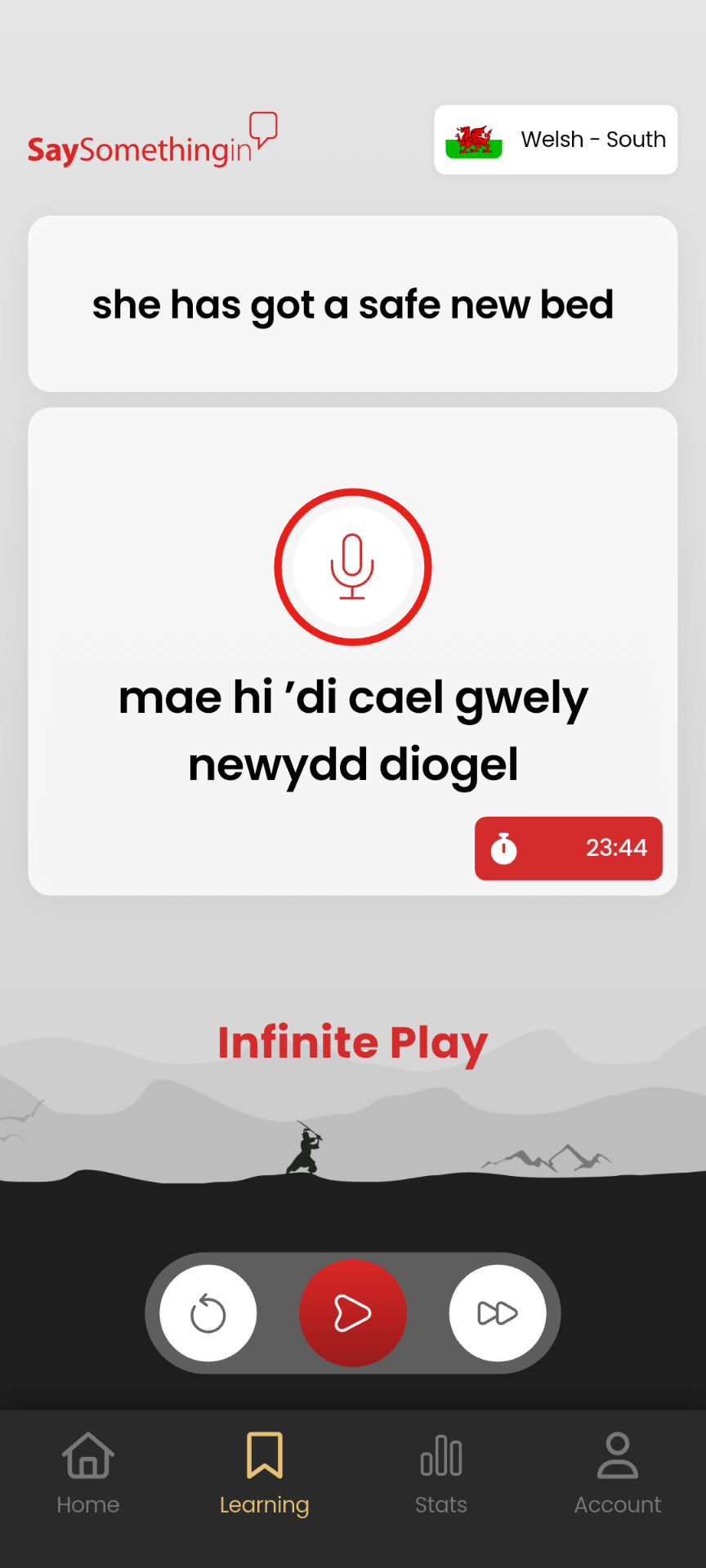
I had translated this as “Mae gwely newydd diogel gyda hi” assuming it was a possessive statement.
I can see that the app translation is correct but wondering if my answer is too, given some possible ambiguity with the English statement?
1 Like
Yup, your answer is entirely fine as well, it’s just that variation that’s possible in the Welsh and kind of hidden in the English
1 Like
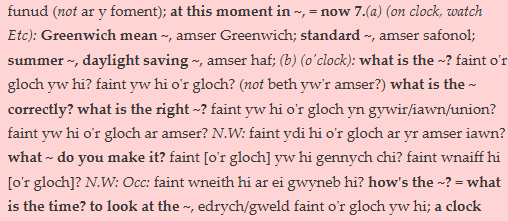
My memory of school Welsh (in South Wales) was that when we asked the time we said “Beth yw’r amser?”.
All the teaching material I’ve looked at these days uses “faint o’r gloch”?
Is “Beth yw’r amser” still in general use or is has it gone out of fashion?
PS with the grandkids we still play “Beth yw’r amser Mr Blaidd”
I would say “beth yw’r amser” is certainly not in general use - it’s a very anglicised word-for-word translation, and in the 30 years since I started learning Welsh, I’ve never heard anyone use it anywhere. Geiriadur Academi even stresses that that is incorrect.
3 Likes
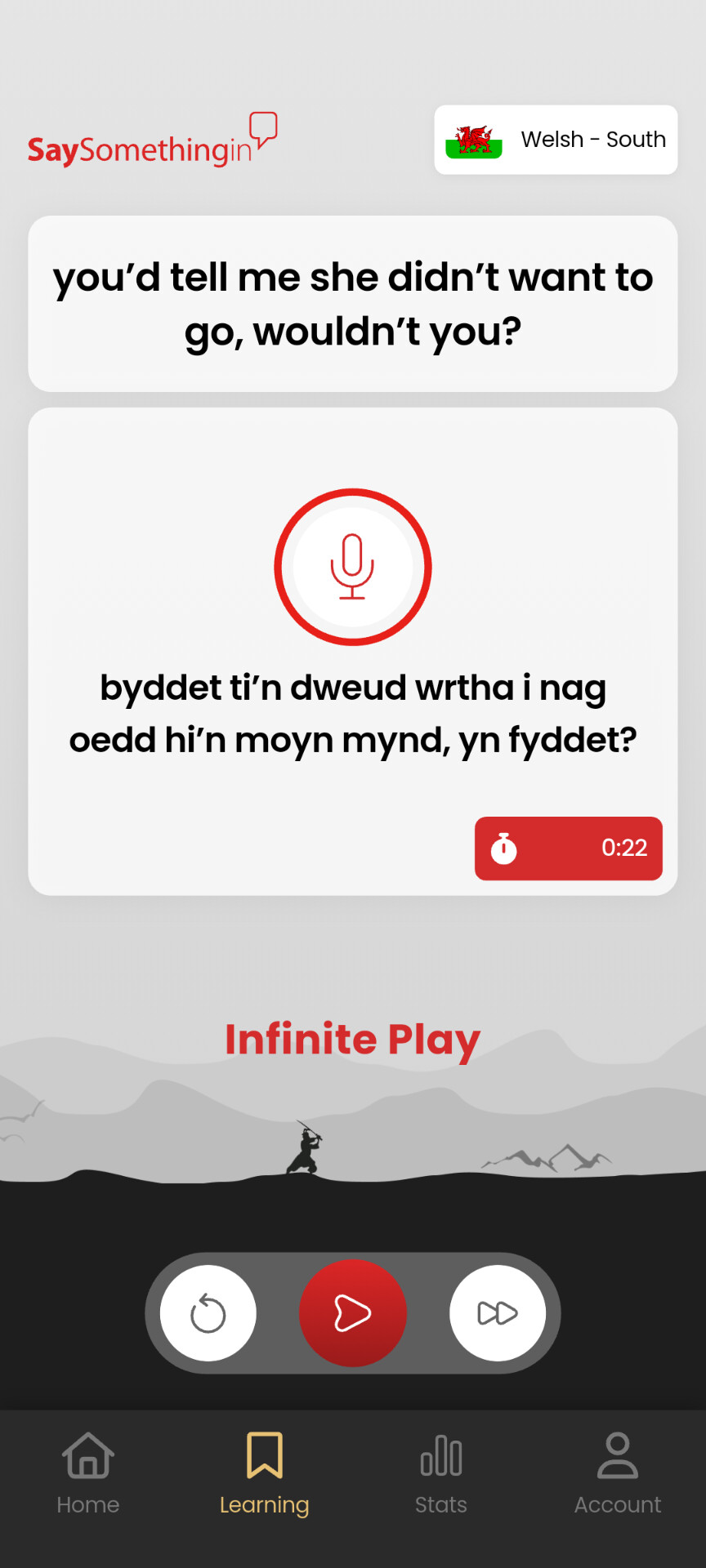
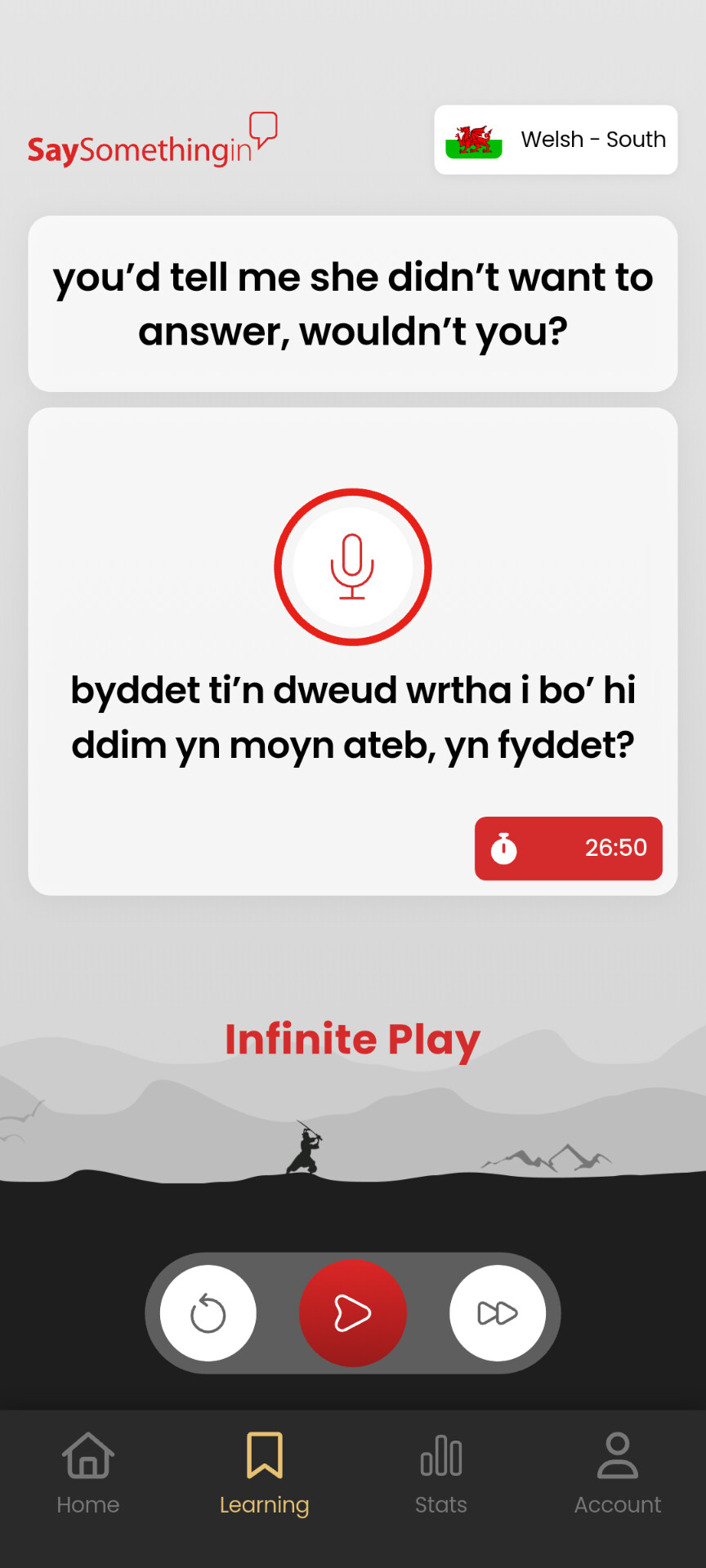
I’d appreciate some help on this one please.
The first example has been the standard translation in my version of the course so far.
Very recently the second translation has crept in.
The English bit is along the lines of “(dah-de-dah)…that she didn’t want to say” or something like that.
The standard translation had been “…bo’hi ddim yn moyn dweud”.
Very recently it has appeared as “…nag oedd hi’n moyn dweud”
I guess my question is around my perennial confusion around when “that” clauses are expressed in present vs imperfect tenses. I’m ok with the use of 'na/nag" for negative that clauses.
1 Like
May I ask about i’w?
I am making my way through the north course for the second time, I didn’t really understand it last time.
Digon i’w fwyta, why and when, anything to help me this time around.
Diolch
1 Like
This is pretty much always context dependent - what did she say at the time? When she spoke did she say “I don’t want to say” or was she at that time referring to a yet earlier time, so she said “I didn’t want to say”. English doesn’t really capture that nuance very well, but Welsh does.
2 Likes
There’s an earlier discussion of this here: Use of 'i'w'
I think this is another example where the obvious English translation is a bit ambiguous out of context. The thread suggests one way to be clear is to translate “i’w” as “to be” (“enough to be eaten”). Or I guess “enough to have it’s eating”, i.e. the thing coming before the “i” is the thing being eaten, in a similar way to the use of the possessive in other passive constructions.
I hope that’s a reasonable summary, Deborah? Trying to check this out suggests that people don’t always get this strictly right… Thanks for the encouragement to figure this out!
3 Likes
Thanks for replying but given the English in these examples how could you possibly guess which Welsh model answer to use? You tell me!
1 Like
You are on infinite play, so you have been at it for long enough to know that Welsh is its own language and not “English, but with Welsh words”. But striving to have both languages still sound natural, you sometimes end up with these ambiguities, where a difference in Welsh doesn’t exist in English. This may seem annoying sometimes (and you certainly sound annoyed!), but this just enforces the idea that Welsh simply “works” differently than English from time to time.
In the long run this is not a problem, though. Because firstly, even if you pick the “wrong” option, the nuances are rather small, so the overall meaning will still be there and you will still be understood. And secondly, in a real life situation you know the temporal relation that you want to convey, so you can build the sentence accordingly.
On a similar level that same ambiguity exists whenever you have to translate “you”: will it be ti or chi? That’s also sometimes impossible to tell from the English prompt alone, but in real life you will know which one to use.
4 Likes
Thank you for your considered reply Hendrik.
I guess it is reassuring to know that based purely on the English in front of you, either answer would be correct.
I think the problem for people with my mindset is that I struggle to understand something, and then when I think I’ve got it (eventually), something like this comes along which destroys the confidence I’ve built up (I don’t deal with ambiguity very well).
Given a desire to be 100% correct as a measure of my progress, i guess I need to learn not to be too frustrated by this sort of ambiguity.
2 Likes
It’s really, really important to accept ambiguity in language learning - there are no two languages that fit perfectly to each other - things will always have an ebb and flow - sometimes something you say in a known language can be said in more than one way in a new languages, sometimes something you could say in more than one way in a known language can only be said in one way in a target language - and at heart, that reflects the way in which language itself is always much messier in speech than we realise, and much more about co-creation of conversation than the pinned down rules of grammar imply.
By the time you’ve reached infinite play, the single most important thing you can be doing is getting into 1:1 conversations with Welsh speakers - that’s where it all comes to life - and the more relaxed and playful you can be about the uncertainty in those situations, the more you’ll enjoy it
4 Likes